First of all:
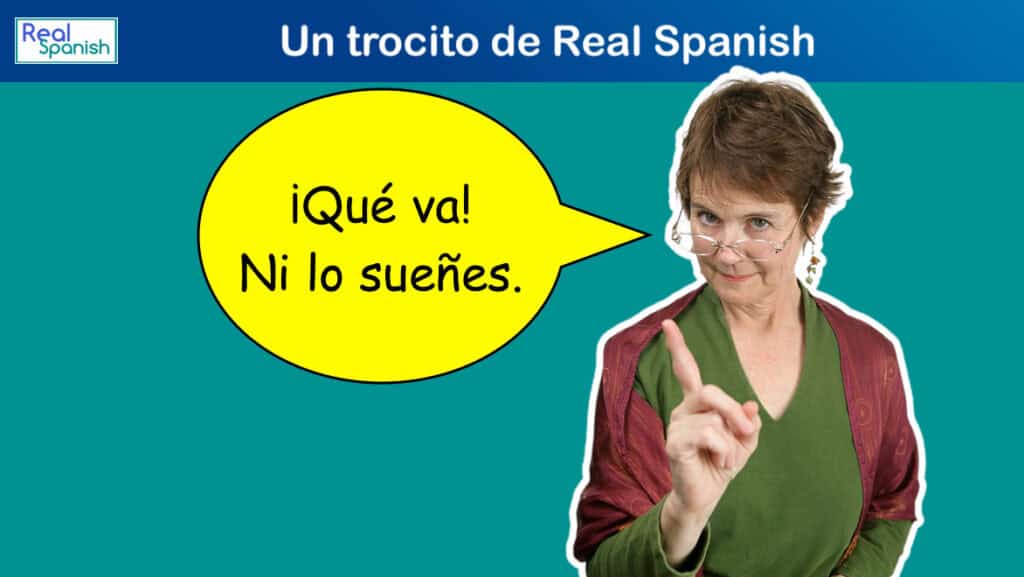
Do you know the expression !Qué va!? We explain it in this video, along with other great ways to give a firm "No!"
If you want to push yourself a bit, try reading this intro in the Spanish version first. You can always come back here if you want to check a particular word or phrase. Just click on "English" or "Español" in the menu above.
By the way: Un trocito is a small piece or bit of something, as in Un trocito de chocolate. This Trocito de Real Spanish is part of a complete lesson in our ebook Spanish for Perfectionists No. 1. See below for more information about our ebooks and a free sample lesson.
Hi. I’m Elizabeth, from Real Spanish, and a keen learner of Spanish, like you.
I collect interesting and useful Spanish phrases, sometimes several in one day— in a movie, a newspaper, a podcast, or just a normal day-to-day interaction with Spanish speakers— it’s become a kind of hobby. I live in Barcelona, so I have plenty of source material.
Spanish is wonderfully expressive and you can add loads of colour and authenticity to your own speech if you have a good repertoire of useful vivid phrases you can use in real conversations with native speakers. They really help to string your ideas together and express what you really mean.
Why not develop your own collection of useful expressions? If you are not surrounded by Spanish speakers every day, how about a language partner online? We have a blog post about that, in English or Spanish. Or you can watch films and TV shows. Did you know that on YouTube and Netflix you can slow down the audio playback for the difficult bits? Don’t know how? We have a video for that! Watch on your computer but keep WordReference.com open on your phone or tablet (or any other combination of two screens, to save you switching back and forth between apps). It’s the best resource I have found for colloquial expressions. Professional translators use it.
The video below explains some great expressions that you can use in real conversations with native speakers to reject an idea, a proposal or a request. I’m sure you already know what ¡Qué va! means. You could translate it as “No way”. But I bet this one sounds strange: ¡Ni qué niño muerto! literally means “Not even a dead child”. Sounds grim, right? We explain its curious origin in the video below, so let’s get on with it.
All the best for your adventures in Spanish,
Elizabeth from Real Spanish
The video: Click the image to view on YouTube
Transcript: Download the PDF Sign up to download the PDF
And a few more for your collection:
Here are a few more examples of these expressions in context. We've also added four more expressions you can use to reject a request, a suggestion, or an idea. Of course you can just say no, but your speech will be more expressive (and impressive) if you can use some of these expressions. Note that some are more formal than others.
| Expression | Comments | Example in context |
|---|---|---|
| ¡Qué va a + infinitivo! ¡Qué va!  |
Colloquial: used exactly the same way as “No way!” or “Not at all!” contradicting what the other person said. | ¿Tu amigo Juan es actor? ¡Qué va a ser actor! Es profesor pero le gusta mucho el teatro.¿Te lo pasaste bien en la fiesta? ¡Qué va! Fue aburridísima, me fui a casa muy temprano. |
¡Ni lo sueñes! |
Colloquial: used exactly the same way as “In your dreams!” or “Don’t even think about it!” | Mamá, ¿me compras estos vaqueros? ¡Ni lo sueñes! Son demasiado ceñidos para ser decentes. |
¡Ni en broma! |
Colloquial: used as “No way!” “Don’t even think about it!” or “You must be joking!” | ¿Estás pensando en volver a vivir con tus padres? ¡Ni en broma! Estoy muy feliz viviendo sola. |
¡Ni hablar! |
Colloquial: used the same way as “Forget about it! or “Don’t even go there!” | ¿Me ayudas con este informe? ¡Ni hablar! La última vez que te ayudé, te llevaste todo el mérito. |
¡Qué _____ ni qué gaitas! |
Colloquial. Use the same way you would use “Not a chance!” or “In your dreams!” Gaitas are Galician bagpipes. The expression means that what is being proposed is not even worth considering. Pretty insulting about Galicia’s famous musical instrument. | ¿Puedo ir al cine con Ana? ¡Qué cine ni qué gaitas! Lo que tienes que hacer es estudiar para el examen de mañana. |
¡Qué_______, ni qué _______! |
Colloquial. Use the same way as the gaitas expressions above. | ¿Puedo ir al cine con Ana? ¡Qué cine ni qué cine! Lo que tienes que hacer es estudiar para el examen de mañana. |
¡Qué_______ ni qué niño muerto! |
Colloquial: “Nonsense!”, or ‘Don’t talk nonsense!’ This expression has nothing to do with dead children, although its origins have to do with arguments about whether children who died before being baptised could be counted in a census. | Voy a escribir un libro sobre mi vida. ¡Pero qué libro ni qué niño muerto! ¡Si tú no has escrito en tu vida! |
¡Anda ya!  |
Colloquial. Can be used as “No way!” or “Come on, get away with you!” | Hoy viene Penélope Cruz a cenar a este restaurante. ¡Anda ya! ¡No te lo crees ni tú! |
En absoluto  |
Quite formal. This doesn’t mean “absolutely”. It means “absolutely not” or “out of the question”. For “absolutely” use the adverb: absolutamente. | ¿Tuviste miedo durante el juicio? En absoluto, estaba muy tranquila. |
De ninguna manera/ningún modo  |
Formal and very explicit: “absolutely not” or there is no way (that)…” | ¿Le va a dar un ascenso en la empresa? De ninguna manera/ningún modo (le doy un ascenso). Llega tarde al trabajo cada dos por tres. |
Bajo ningún concepto  |
Formal and very strong: “under no circumstances”. | No me importa lo mal que se sienta, no permito el uso de este tipo de lenguaje bajo ningún concepto. |
Frequently asked questions
What does "¡Qué va!" mean?
It's used to deny something emphatically — something like "no way" or "not a chance." It's a very colloquial way to contradict what someone just said.
Where does "¡Ni qué niño muerto!" come from?
It's one of the most curious ways to reject something in Spanish, and it comes from an old belief: centuries ago, a child who died before being baptized wasn't legally considered a person, so "a dead child" was equivalent to "nothing at all." Saying "¡pero qué libro ni qué niño muerto!" is literally saying that whatever "book" was just mentioned counts for just as little. The RAE records this construction as being used "in exclamatory constructions introduced by qué to emphatically express rejection or scorn toward what was just mentioned."
What does "¡Ni qué gaitas!" mean?
It's a close cousin of "¡ni qué niño muerto!" — used exactly the same way, by repeating whatever you want to dismiss ("¡qué cine ni qué gaitas!" — "the movies? no way!"). La gaita is the traditional bagpipe of Galicia, and although nobody thinks about the literal meaning any more, the expression implies that whatever's being proposed "isn't worth it" — much like, apparently, a bagpipe wasn't, to whoever coined the phrase.
What's the difference between "¡Ni en broma!" and "¡Ni hablar!"?
Both are colloquial and both reject something firmly, but with a slightly different flavor. "¡Ni en broma!" — which the RAE lists as a way to intensify a negation ("eso no lo digas ni en broma," "don't even say that as a joke") — stresses that you wouldn't do it even in jest. "¡Ni hablar!," on the other hand, which the RAE defines as a formula "used to reject or deny a proposal," is more often used to shut down a specific request someone has just made.
How do you say "no" more formally in Spanish?
If "¡qué va!" and its colloquial cousins feel too casual for the situation, Spanish has stronger, more formal alternatives: "en absoluto" (neutral and polite), "de ninguna manera" or "de ningún modo" (blunter), and "bajo ningún concepto" (the strongest of the three).
More questions? Just ask us in the comments!
How did you like this video?
If you enjoyed this Trocito, I think you’ll like this one too, featuring the expression “Con el culo al aire” and other Spanish idioms featuring body parts. As you can imagine, a couple are a bit vulgar.
If you like learning expressions like these, check out our YouTube playlists.
You might also be interested in our new series of videos and ebooks Spanish for Perfectionists. You can get a free sample lesson and a free Guide for users that’s full of practical tips for language learners.
Ready for something more demanding? Take a look at our online Spanish courses.