Trocitos de Real Spanish

Un trocito de Real Spanish | "¡Ni qué niño muerto!" and other ways to give a firm "no!" in Spanish

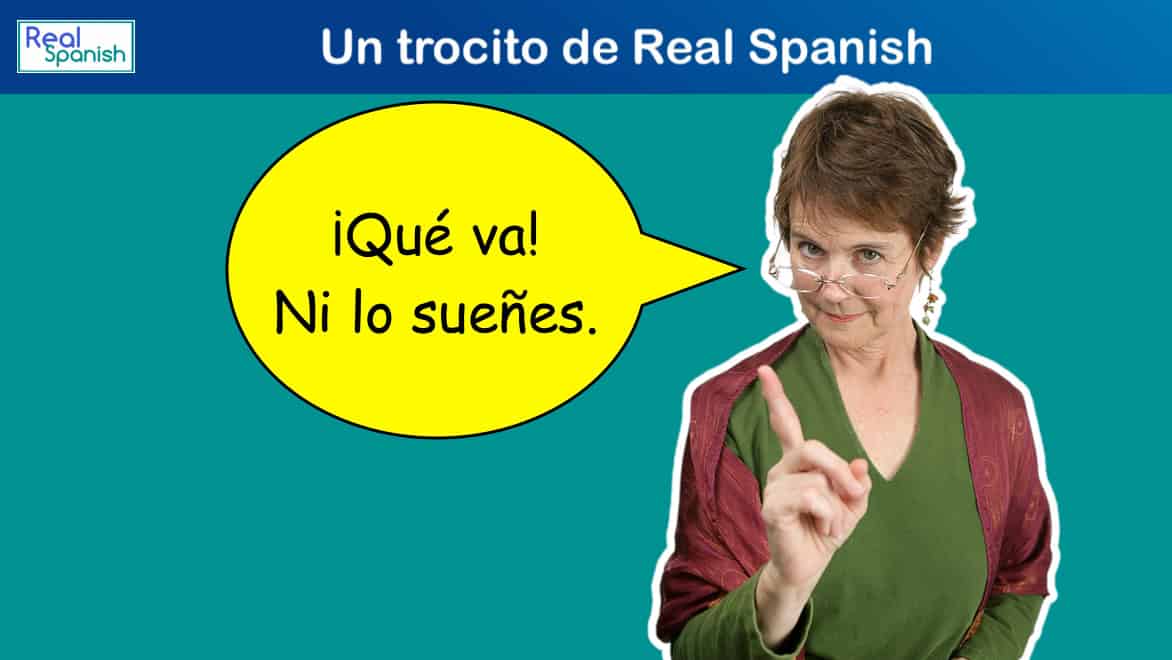
First of all:  If you want to push yourself a bit, try reading this intro in the Spanish version first. You can always come back here if you want to check a particular word or phrase. Just click on "English" or "Español" in the menu above. Note: the video below is part of a complete lesson in our ebook "Spanish for Perfectionists No. 1". See below for more information about our ebooks and a free sample lesson.    Hi. I’m Elizabeth, from Real Spanish, and a keen learner of Spanish, like you. I collect interesting and useful Spanish phrases, sometimes several in one day— in a movie, a newspaper, a podcast, or just a normal day-to-day interaction with Spanish speakers— it’s become a kind of hobby. I live in Barcelona, so I have plenty of source material. Spanish is wonderfully expressive and you can add loads of colour and authenticity to your own speech if you have a good repertoire of useful vivid phrases you can use in real conversations with native speakers. They really help to string your ideas together and express what you really mean. Why not develop your own collection of useful expressions? If you are not surrounded by Spanish speakers every day, how about a language partner online? We have a blog post about that, in English or Spanish. Or you can watch films and TV shows. Did you know that on YouTube and Netflix you can slow down the audio playback for the difficult bits?  Don’t know how? We have a video for that! Watch on your computer but keep WordReference.com open on your phone or tablet  (or any other combination of two screens, to save you switching back and forth between apps). It’s the best resource I have found for colloquial expressions. Professional translators use it. The video below explains some great expressions that you can use in real conversations with native speakers to reject an idea, a proposal or a request. I’m sure you already know what ¡Qué va! means. You could translate it as “No way”. But I bet this one sounds strange: ¡Ni qué niño muerto! literally means “Not even a dead child”. Sounds grim, right? We explain its curious origin in the video below, so let’s get on with it. All the best for your adventures in Spanish, Elizabeth from Real Spanish   The video: Click the image to view on YouTube   Transcript: Niño muerto transcription Aug 25   And a few more for your collection: Here are a few more expressions you can use to reject a request, a suggestion, or an idea. Of course you can just say no, but your speech will be more expressive (and impressive) if you can use some of the expressions below. Some are more formal than others. Expression Comments Example in context ¡Qué va a + infinitivo! ¡Qué va! Colloquial: used exactly the same way as “No way!” or “Not at all!” contradicting what the other person said. ¿Tu amigo Juan
“El mar” or “la mar”? Well, that depends!

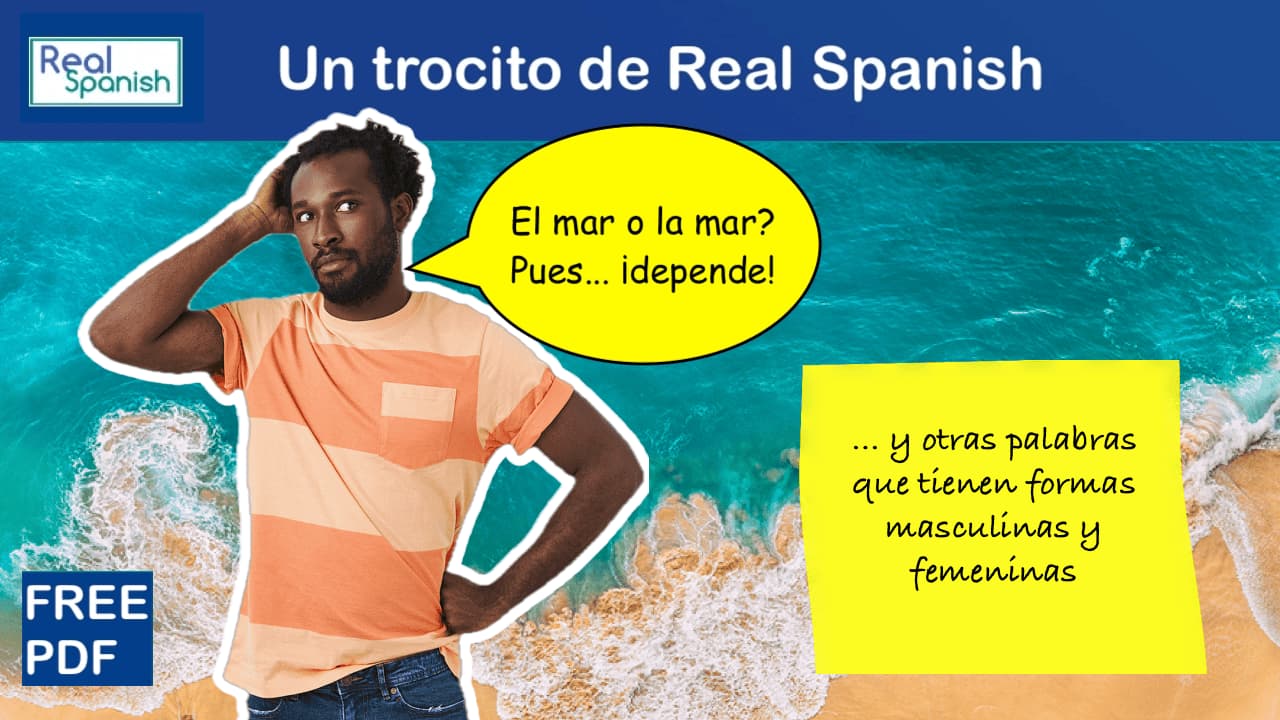
“El mar” or “la mar”? Well, that depends!   First of all: This video is one of our “Trocitos de Real Spanish” (Little Bits of Real Spanish). A trocito is a small amount of something — usually something to eat, like a trocito of chocolate! This particular one is a preview of a full lesson from our ebook Spanish for Perfectionists No. 1. Below you'll also find a link to a free sample lesson from Spanish for Perfectionists No. 2.   Hi there! I'm Elizabeth from Real Spanish, and like you, I'm passionate about learning Spanish. After all these years of studying, I thought I'd pretty much figured out which nouns are masculine and which are feminine. What a surprise it was to discover that el mar and la mar both exist! Same word, two genders, and a nuance of difference between them that's worth knowing. The video below explains when to use el mar and when to use la mar, plus several really cool expressions with the word mar that native speakers use all the time. Heads up: a couple of them are a little vulgar!   To view the video, click on the image. Transcript: Download the PDF     Bonus: a poem, and a few more expressions El mar. La mar. El mar. ¡Sólo la mar! ¿Por qué me trajiste, padre, a la ciudad?   Rafael Alberti, Marinero en Tierra (1924) (“The sea. The sea. The sea, only the sea! Father, why did you bring me to the city?”)   That's how one of Rafael Alberti's best-known poems opens (1902–1999, born in Puerto de Santa María, Cádiz). Notice he uses both genders: el mar of the city-dweller, and la mar of the sailor, who longs for the sea of his childhood. There's the nuance we talked about in the video, turned into poetry.   And while we're at it,… … a couple more details about mar that don't come up in the video: it's also used in the feminine when followed by an adjective describing its state, like mar gruesa (rough sea), mar rizada (choppy sea), or mar llana (calm sea). And in poetry and literature generally, la mar is preferred, because it sounds more expressive and emotive, as Alberti shows. A couple more expressions for your collection: pelillos a la mar is used to say we're making up after an argument — roughly "let bygones be bygones." And if you hear about goods de ultramar, it means merchandise that's come from far away, from the other side of the sea — which is also where ultramarinos comes from, the traditional word for a grocery store. Here I actually had to check which preposition was correct: sacar partido a or sacar partido de ("to make the most of"). To my surprise, both are correct. I checked with a very authoritative source, and it occurred to me this might be a useful resource for some of you too: the Fundación del Español Urgente (FundéuRAE).   Frequently asked questions

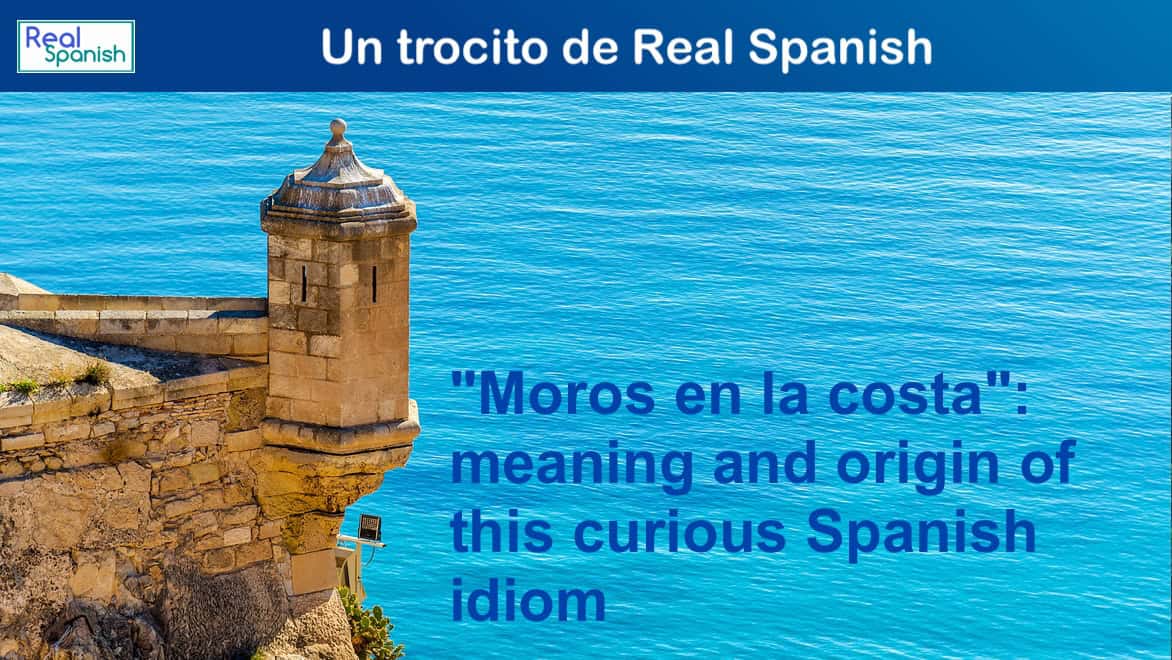
Un trocito de Real Spanish | "Moros en la costa": meaning and origin of this curious Spanish idiom

First of all: This is the English version of the transcript of one of our "Trocitos de Real Spanish". Un trocito is a little bit of something (usually something to eat). This Trocito is a preview of our online Spanish course “Español con noticias y documentales 2: La historia de tres regiones bilingües de España”. The additional learning materials referred to in the video are available in the complete course. You’ll find a link to this and all our courses below. If you want to push yourself, try reading the Spanish version of this blogpost and video transcript first (just click on “español” in the menu above) — then come back here to check anything you're not sure about.   Hello! I’m Elizabeth, from Real Spanish, and a dedicated student of Spanish. I love learning new expressions in Spanish. As you know, most of them can’t be translated literally because they are based on the culture and history of the Spanish-speaking world. Some are local to a particular country or region. Some are so interesting that they deserve a video all to themselves! If you’ve spent any time with Spanish speakers, you’ve probably heard someone suddenly lower their voice and mutter ¡Moros en la costa! — maybe when the boss walks in, or when a sibling appears at an inconvenient moment. But where does this expression come from, and what do Moors have to do with it? The story takes us back to medieval Spain, a network of coastal watchtowers (torres vigía), and a very real danger that kept entire villages on permanent alert for centuries. The video below explains the origin of ¡Moros en la costa!, one of the most colourful idioms in everyday Spanish, which can be traced back to its historical roots: the constant raids by North African Muslims along the Mediterranean coast, and the very real danger that kept coastal villages on permanent alert. It also touches on a related expression, prometer el oro y el moro, and looks honestly at why both expressions carry some cultural baggage worth knowing about. Wishing you all the best for your adventures in Spanish, Elizabeth from Real Spanish Click on the image to view the video   Download the transcript Interesting! That’s the magic of expressions like this one — they’re living fossils of the culture that created them. Every time a Spanish speaker whispers ¡Moros en la costa! across a dinner table, they’re unknowingly echoing the voice of a medieval lookout scanning the horizon for sails.   If you enjoyed this video, you'll like a related video featuring the expression “Como Pedro por su casa”, another popular Spanish saying based on historical events. You might also be interested in the  complete course “Español con noticias y documentales 2: Tres regiones bilingües de España”. Visit us to learn more and try some free sample lessons. If you like learning expressions like this, check out our YouTube playlists. Ready for something more demanding? Take a look at our online Spanish

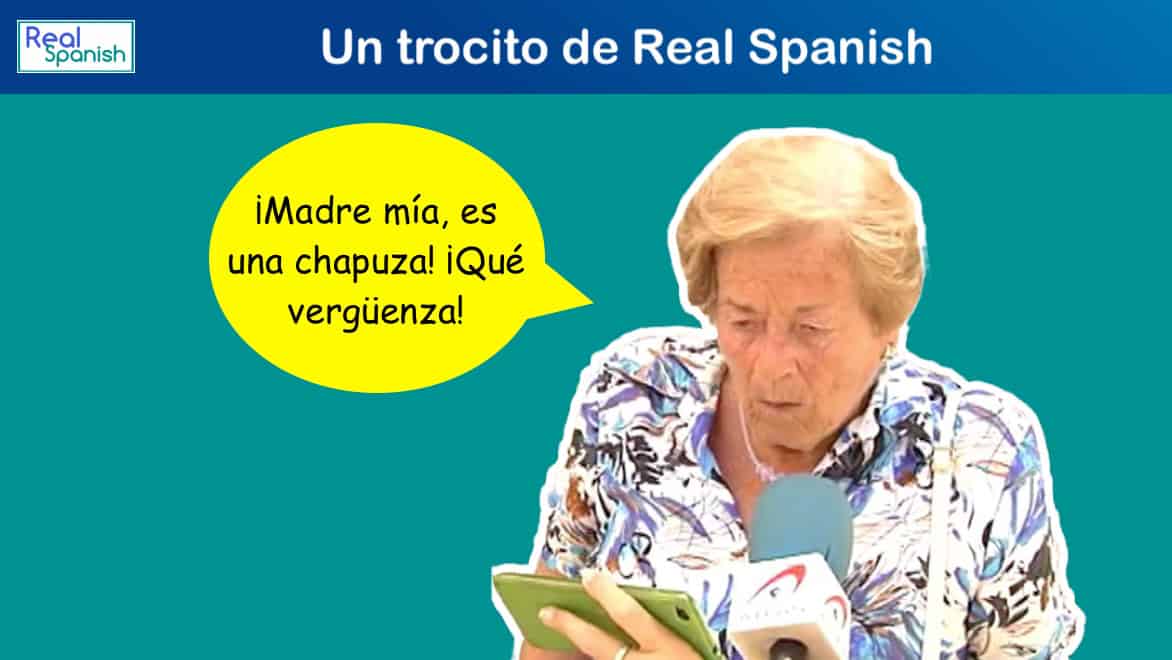
Un trocito de Real Spanish | “¡Qué vergüenza!": A Spanish art disaster

First of all: This video is one of our “Trocitos de Real Spanish” — short clips from our Spanish lessons to help you get used to real, everyday Spanish. A trocito literally means “a little piece” of something — usually something you can eat, like un trocito de queso (“a little piece of cheese”). This particular one is a preview of the full lesson ¡Es una chapuza!, from our course Español con noticias y documentales 1: Entrevistas y reportajes.   Hi there! I'm Elizabeth from Real Spanish, and like you, I'm passionate about learning Spanish. This video is all about Spain’s artistic heritage — and what happens when a restoration goes so badly wrong that it becomes a national embarrassment. Some of these stories were so shocking that they even made the news in other countries. And there’s more! You’ll also come across one of the most famous Spanish “false friends”: embarazada does not mean “embarrassed”... although you probably already knew that!   Click on the image to view the video.   Transcript: Download the PDF Note: This transcript has been slightly updated to reflect our current courses and resources, so the video may differ slightly from the text. We recommend listening to the audio first with the transcript, then without it, until you can make out every word. You can even repeat some sentences after the narrator, then record yourself and compare your pronunciation with hers. Keep going until you really do sound better.   Bonus: update on this story The world's most famous restoration chapuza happened in 2012, in the town of Borja, near Zaragoza. Cecilia Giménez, a local resident, took it upon herself to restore a 19th-century fresco titled Ecce Homo, painted by Elías García Martínez, in the Sanctuary of Mercy church. The result — Christ's face turned into something resembling a hairy monkey — went viral worldwide under the nickname Mono Cristo (“Monkey Christ”). Cecilia Giménez died on 31 December 2025, at the age of 94. But against all odds, her botched restoration had a happy ending: over 150,000 tourists have visited Borja to see the fresco for themselves, a small museum dedicated to the story opened in 2016, and she herself went on to exhibit 28 of her own paintings in the town. You can read the full story at The Art Newspaper. Links to related articles La leyenda de San Jorge y el dragón How 'Monkey Christ' brought new life to a quiet Spanish town 10 restauraciones de edificios en España que todos lamentan y ya no tienen vuelta atrás Botched Spanish statue that went viral is lovingly unrestored Spain’s latest ‘Ecce Homo’: how a botched restoration made global headlines Spanish statue bodge-up is a new rival to Borja's Monkey Christ Frequently asked questions What does una chapuza mean? It's a colloquial word for a shoddy, badly-done job — especially building or DIY work. According to the RAE, a chapuza is “work done badly and without care” (RAE's own gloss, translated here). Is avergonzado

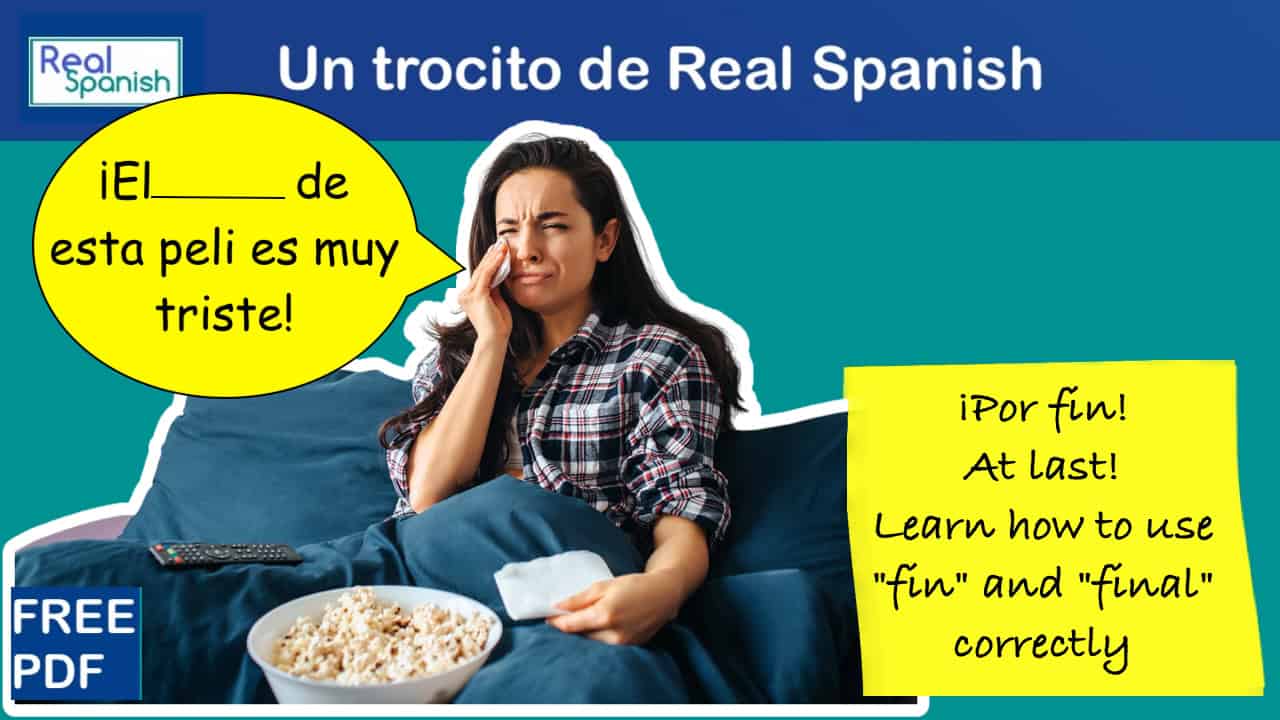
¡Por fin! At last! We help you to use «fin and «final» correctly.

  The video above explains some uses of «fin» and «final». The English transcription is below. If you just want to listen to the audio, you can find it on Soundcloud.  ¡Hi, and welcome to Real Spanish!   Do you still have trouble with «fin» and«final»? Do we say  «el fin» or «el final» of a movie? The first thing you need to know is that «fin» has three differen meanings. It can mean the end of something,  such as the end of the week, («el fin de semana») or, more colloquially, «el finde»). For example: «Este finde vamos a la playa». It can also mean the objective or motive for some action, such as, «El fin de su viaje era visitar a su madre». We use the connectors  «a fin de» or «con el fin de» with the meaning of «para». For example: «Estoy estudiando inteligencia artificial, a fin de prepararme para lo que venga en el futuro». «Se ha aprobado una nueva ley con el fin de limitar los precios del alquiler». But «fin» can  also mean a limit or border, as in «Esta línea representa el fin del terreno del parque». The word«final» also means «la parte final de algo», and in this case «fin» and «final» are interchangeable. Look at these examples: «Todos estamos rogando por el fin/el final de la guerra». «No consigo llegar a fin/final de mes». However, why do we usually say, «el final del libro» instead of «el fin del libro»? Well. it's because «el fin del libro» could be interpreted as the aim or objective of the book. Ah, and another difference: «final» can be an adjective as well as a noun, whereas «fin» is only a noun.  For example: «París fue el destino final de nuestro viaje». Y ahora algunas expresiones útiles: Por fin (at last) Al final (in/at the end) A/para /hasta finales de (at/by/until the end of...) Well, the aim of this vidoeowas to explain some uses of  «fin» and «final». And now we've come to the end. Bye for now!   Please leave us a comment, a question, or a suggestion below: we’d love to hear from you! Follow us on YouTube so you never miss our Trocitos de Real Spanish. You can also participate in our Community page on YouTube.  You'll find short quizzes, surveys, and quick explanations of vocabulary or grammar points.   Enjoy your Spanish with us! Click here to learn more about all our great materials.  Real Spanish: online Spanish courses and mini-lessons for people who are serious about improving their Spanish

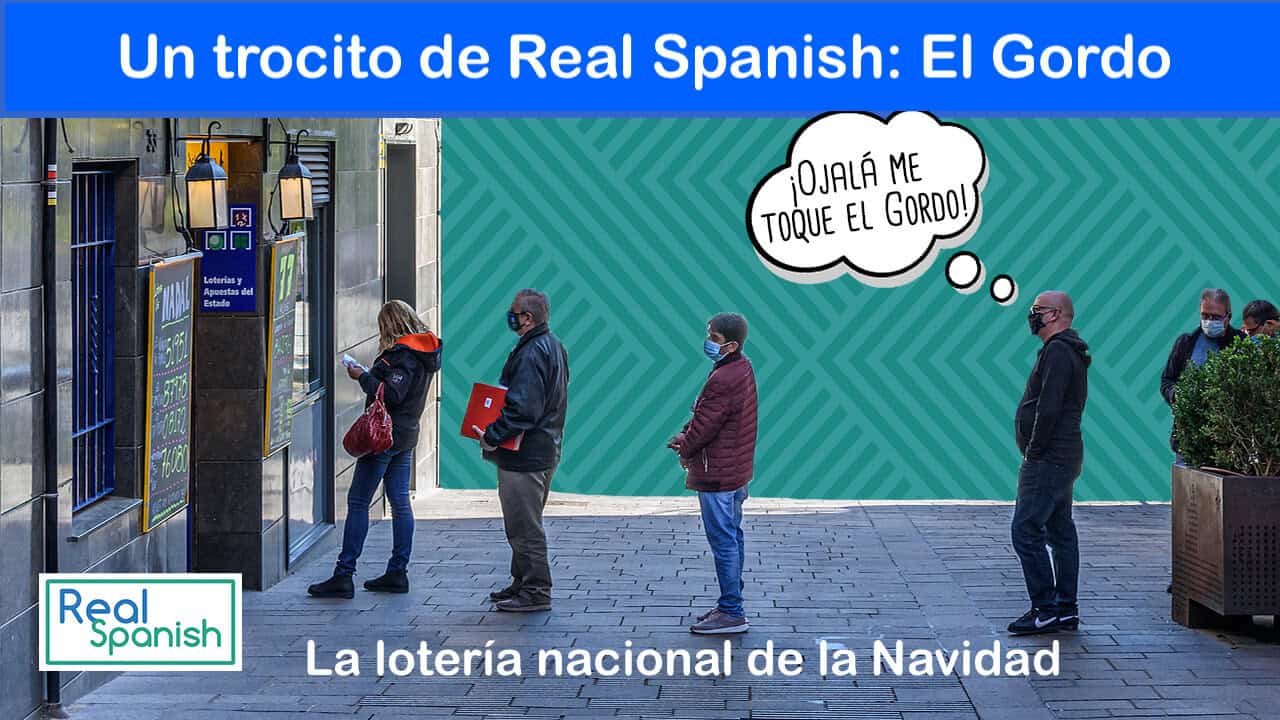
¡Ojalá me toque El Gordo! La lotería de Navidad en España

This lottery takes place in the Teatro Real or the Palacio de Congresos in Madrid and crowds of people attend. Children from San Ildefonso school, one of the oldest in Madrid with more than 400 years of history, practise singing out the winning numbers. One child takes out a numbered ball from a rotating drum and the other takes out of another drum ball that announces the prize for that number. The first prize is known as El Gordo (The Big One) and the winner receives 400,000 euros. The ticket with the number is known as el decimo (one tenth), because each number appears on ten different tickets: that is, there are ten tickets with the same number. There are four other prizes as well as El Gordo, worth from 125,000 euros (second prize) to 6,000 euros (fifth prize). Then there is what’s known as La Pedrea, consisting of lots of smaller prizes. Crowds of people queue up at the lottery offices to buy tickets, which cost 20 euros each. The most famous place to buy tickets is Doña Manolita, en Madrid, which started in 1904 and became very popular because so many of the tickets sold there won prizes. Many people buy shares in a ticket; that is, a ticket is shared among friends and family. Sometimes local businesses sell shares to their customers. The cost of shares is much lower and the prizes are shared among all the participants.   The television advertisements for the lottery (see below) feature moving stories which encourage solidarity. The message is: “The best prize is sharing.” If you are in Spain around these dates, why not try your luck by buying a ticket or a share? Share the dream! Links to other articles and videos: Wikipedia article (in Spanish or English and several other languages): Sorteo Extraordinario de Navidad TV ad for the 2019 lottery: TV ad for the 2025 lottery: Sign up or log in  to learn more about all our great materials