
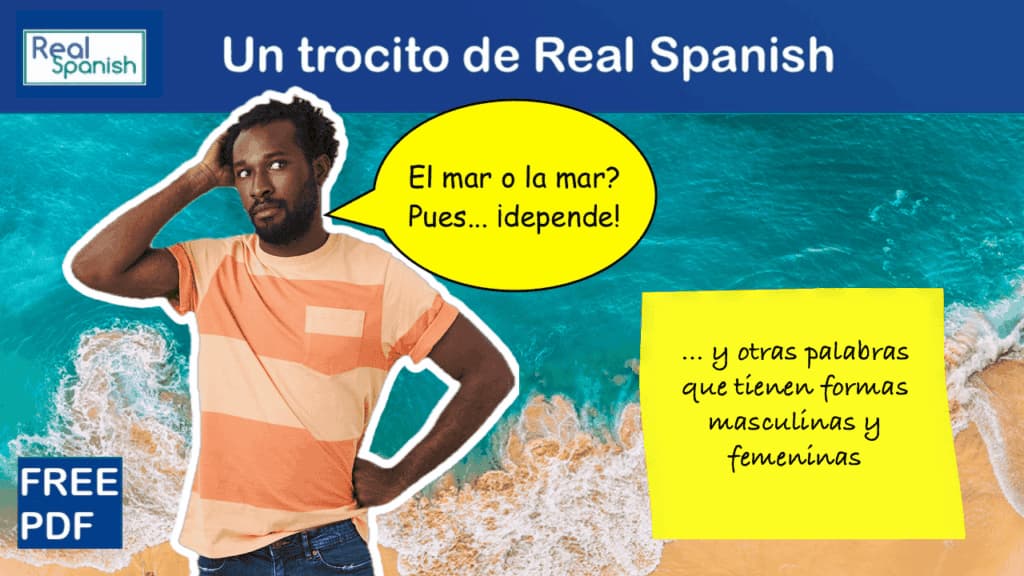
“El mar” or “la mar”? Well, that depends!
First of all:
This video is one of our “Trocitos de Real Spanish” (Little Bits of Real Spanish). A trocito is a small amount of something — usually something to eat, like a trocito of chocolate! This particular one is a preview of a full lesson from our ebook Spanish for Perfectionists No. 1. Below you'll also find a link to a free sample lesson from Spanish for Perfectionists No. 2.
Hi there! I'm Elizabeth from Real Spanish, and like you, I'm passionate about learning Spanish.
After all these years of studying, I thought I'd pretty much figured out which nouns are masculine and which are feminine. What a surprise it was to discover that el mar and la mar both exist! Same word, two genders, and a nuance of difference between them that's worth knowing.
The video below explains when to use el mar and when to use la mar, plus several really cool expressions with the word mar that native speakers use all the time. Heads up: a couple of them are a little vulgar!
To view the video, click on the image.
Transcript: Download the PDF
How to get the most out of the video and transcript
The transcript is the exact text of the video script. Read it before watching the video if you like, but always read it afterwards while you listen to the audio, several times. As you listen, pay attention to intonation, phrasing, pace and the individual sounds of Spanish.
Then choose a sentence or two to read aloud in time with the speaker, imitating them as closely as you can. Later you can record yourself and compare your speech with theirs. This procedure works well:
- Listen and repeat several times, imitating the speaker as closely as possible.
- When you’re ready, record yourself.
- Listen to the speaker again and immediately listen to yourself.
- Repeat until you’re satisfied that your pronunciation is closer to the speaker’s.
Doing this several times over a few days, and several more times over the next few weeks, will help tune your ear to Spanish and make your own speech easier to understand. It’s unlikely that adults who start learning a language after puberty will end up with a native-speaker accent, but with persistence you can sound more natural and less hesitant, feel more confident, speak more fluently and, above all, be understood.
You have to do the work!
This method is probably more work than you expected... but repetition is essential for learning a language and developing fluency. There are no shortcuts, but we promise you’ll enjoy learning with our engaging video lessons.
Bonus: a poem, and a few more expressions
El mar. La mar.
El mar. ¡Sólo la mar!
¿Por qué me trajiste, padre,
a la ciudad?
Rafael Alberti, Marinero en Tierra (1924)
(“The sea. The sea. The sea, only the sea! Father, why did you bring me to the city?”)
That's how one of Rafael Alberti's best-known poems opens (1902–1999, born in Puerto de Santa María, Cádiz). Notice he uses both genders: el mar of the city-dweller, and la mar of the sailor, who longs for the sea of his childhood. There's the nuance we talked about in the video, turned into poetry.
And while we're at it,…
… a couple more details about mar that don't come up in the video: it's also used in the feminine when followed by an adjective describing its state, like mar gruesa (rough sea), mar rizada (choppy sea), or mar llana (calm sea). And in poetry and literature generally, la mar is preferred, because it sounds more expressive and emotive, as Alberti shows.
A couple more expressions for your collection: pelillos a la mar is used to say we're making up after an argument — roughly "let bygones be bygones." And if you hear about goods de ultramar, it means merchandise that's come from far away, from the other side of the sea — which is also where ultramarinos comes from, the traditional word for a grocery store.
Here I actually had to check which preposition was correct: sacar partido a or sacar partido de ("to make the most of"). To my surprise, both are correct. I checked with a very authoritative source, and it occurred to me this might be a useful resource for some of you too: the Fundación del Español Urgente (FundéuRAE).
Frequently asked questions
“El mar” or “la mar”: which is correct?
Both are correct. El mar is the standard, more common form; la mar is used mainly among fishermen and sailors, and also in poetry and literature, because it sounds more expressive and emotive.
Why does the word "mar" have both a masculine and a feminine form?
It comes from the Latin mare, which was neuter. As Spanish evolved, the word kept both forms, masculine and feminine, each with its own uses and contexts (according to the RAE).
What does "la mar de" mean?
It's a colloquial way of saying “a lot” or “very.” For example, estamos la mar de contentos means "we're really happy."
What does "¡me cago en la mar!" mean?
It's an expression of frustration or annoyance: a little vulgar, but quite mild, similar to "bloody hell!" in English.
More questions? Drop us a comment below and we'll get back to you!
If you enjoyed this video and want to keep improving your Spanish, take a look below:
We have more Trocitos for when you don’t have much time. Check out our YouTube playlists.
Do you have a couple of hours? You might also be interested in our new series of ebooks and videos, with complete lessons (transcript, vocabulary notes, grammar worksheet, and online activities) on many topics as interesting as this one. Perfect if you want to push yourself beyond intermediate level. You can get a free sample lesson and User Guide. In the free guide you'll find some really useful learning strategies to help you get the most out of the video and lesson materials, and to become a better language learner overall.
At Real Spanish, you can find other free resources: videos, transcripts, vocabulary lists, and practice and testing activities. I hope to see you there!
Already feel ready for something more challenging? You can try a couple of free lessons from our online Spanish courses, which will take you a few steps further. They are based on clips from TV shows, documentaries, popular films, and radio drama. You’ll be hooked!