
Learn Colloquial Spanish Expressions

Are you somewhere between intermediate and advanced levels in Spanish? Have you noticed that the more Spanish you learn, the more you realise there is still to learn? You know “pastilla” (a pill or tablet) — but do you know the expression “a toda pastilla”? Or how about “ni que gaitas”? You can look up “gaitas” (bagpipes), but what does the phrase actually mean?

And then there are all the ways to express agreement, disagreement, refusal, or an offer of help… the list is endless. Plus the words and phrases that pop up in specific situations: making or receiving a phone call, preparing for a job interview, or joining a conversation about bullfighting (if you dare!).

That’s why we created this section. Quite a few of these posts include one of our YouTube videos, Trocitos de Real Spanish, focused on the idioms, everyday expressions, and colloquial phrases that Spanish speakers use all the time. Drop them into conversations and you’ll sound great.

Come across a word or phrase you just can’t figure out? Drop us a comment — we’d love to help!

¡Vamos allá!

Elizabeth from Real Spanish

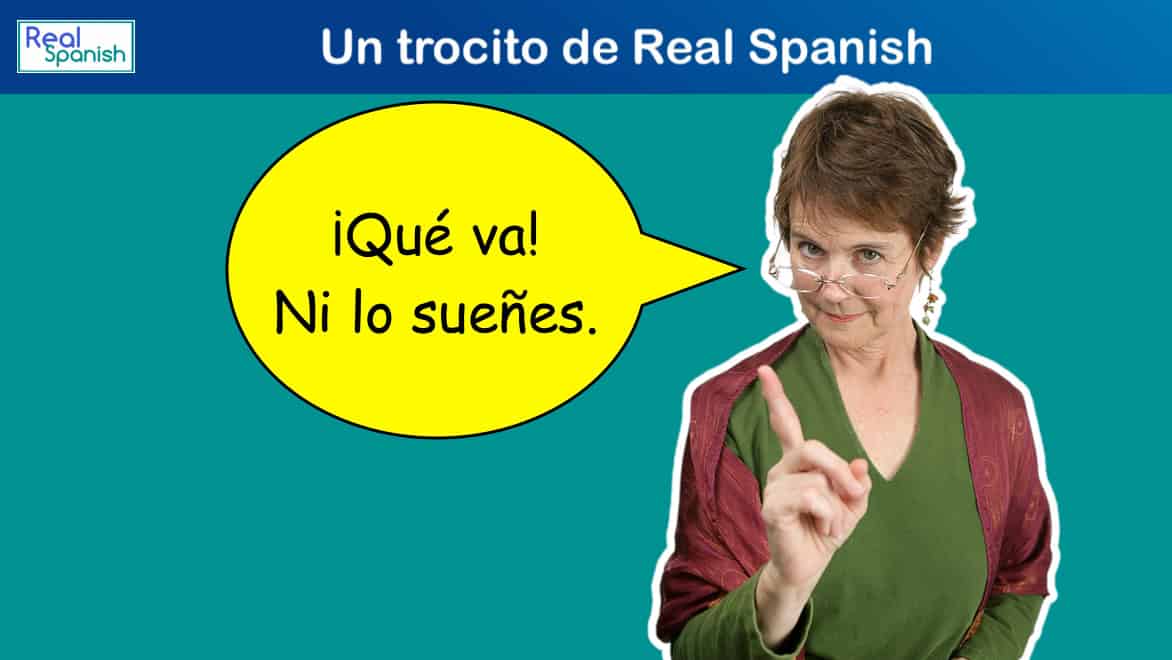
Woman scoding, wagging finger: "¡Qué va! ¡Ni lo sueñes!"

Un trocito de Real Spanish | "Pero ¿Qué fiesta? ¡Ni qué niño muerto!" and other great ways to give a firm "no!" in Spanish

First of all:  Do you know the expression !Qué va!? We explain it in this video, along with other great ways to give a firm "No!" If you want to push yourself a bit, try reading this intro in the Spanish version first. You can always come back here if you want to check a particular word or phrase. Just click on "English" or "Español" in the menu above.  By the way: Un trocito is a small piece or bit of something, as in Un trocito de chocolate. This Trocito de Real Spanish is part of a complete lesson in our ebook Spanish for Perfectionists No. 1. See below for more information about our ebooks and a free sample lesson.    Hi. I’m Elizabeth, from Real Spanish, and a keen learner of Spanish, like you. I collect interesting and useful Spanish phrases, sometimes several in one day— in a movie, a newspaper, a podcast, or just a normal day-to-day interaction with Spanish speakers— it’s become a kind of hobby. I live in Barcelona, so I have plenty of source material. Spanish is wonderfully expressive and you can add loads of colour and authenticity to your own speech if you have a good repertoire of useful vivid phrases you can use in real conversations with native speakers. They really help to string your ideas together and express what you really mean. Why not develop your own collection of useful expressions? If you are not surrounded by Spanish speakers every day, how about a language partner online? We have a blog post about that, in English or Spanish. Or you can watch films and TV shows. Did you know that on YouTube and Netflix you can slow down the audio playback for the difficult bits?  Don’t know how? We have a video for that! Watch on your computer but keep WordReference.com open on your phone or tablet  (or any other combination of two screens, to save you switching back and forth between apps). It’s the best resource I have found for colloquial expressions. Professional translators use it. The video below explains some great expressions that you can use in real conversations with native speakers to reject an idea, a proposal or a request. I’m sure you already know what ¡Qué va! means. You could translate it as “No way”. But I bet this one sounds strange: ¡Ni qué niño muerto! literally means “Not even a dead child”. Sounds grim, right? We explain its curious origin in the video below, so let’s get on with it. All the best for your adventures in Spanish, Elizabeth from Real Spanish   The video: Click the image to view on YouTube   Transcript: Niño muerto transcription Aug 25   And a few more for your collection: Here are a few more expressions you can use to reject a request, a suggestion, or an idea. Of course you can just say no, but your speech will be more expressive (and impressive) if you can use some of the expressions below.

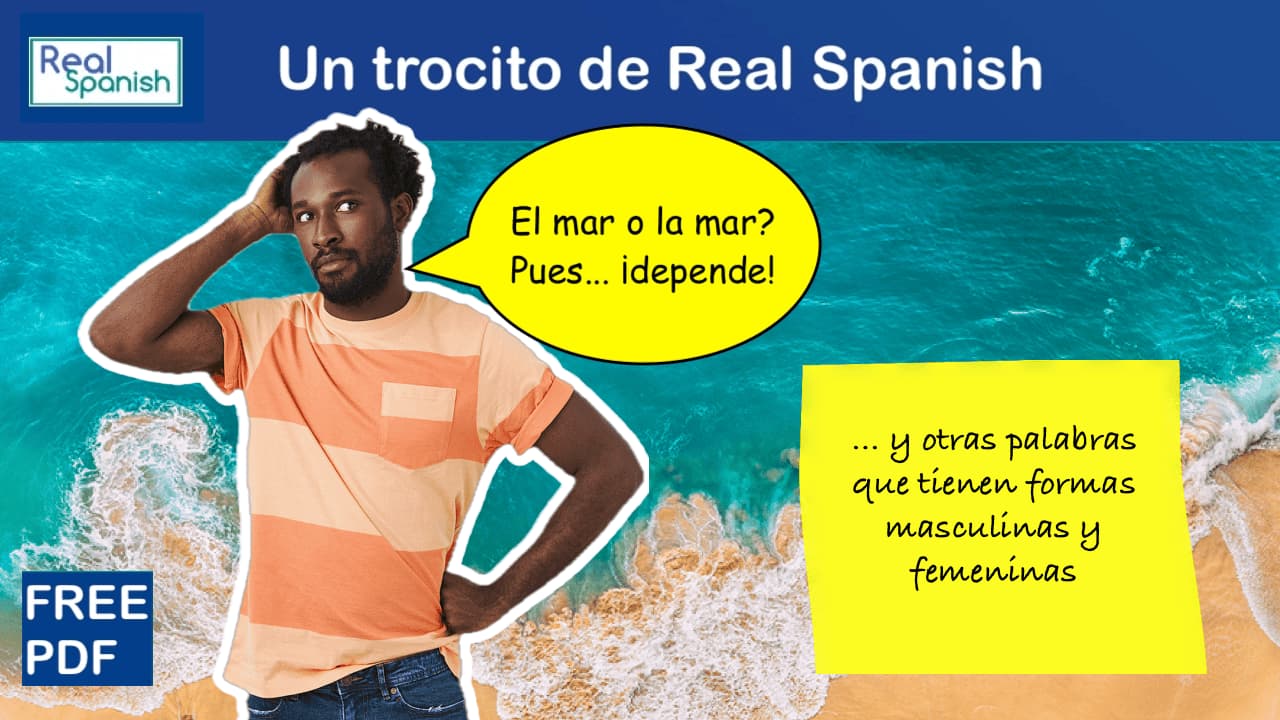
“El mar” or “la mar”? Well, that depends!

“El mar” or “la mar”? Well, that depends!   First of all: This video is one of our “Trocitos de Real Spanish” (Little Bits of Real Spanish). A trocito is a small amount of something — usually something to eat, like a trocito of chocolate! This particular one is a preview of a full lesson from our ebook Spanish for Perfectionists No. 1. Below you'll also find a link to a free sample lesson from Spanish for Perfectionists No. 2.   Hi there! I'm Elizabeth from Real Spanish, and like you, I'm passionate about learning Spanish. After all these years of studying, I thought I'd pretty much figured out which nouns are masculine and which are feminine. What a surprise it was to discover that el mar and la mar both exist! Same word, two genders, and a nuance of difference between them that's worth knowing. The video below explains when to use el mar and when to use la mar, plus several really cool expressions with the word mar that native speakers use all the time. Heads up: a couple of them are a little vulgar!   To view the video, click on the image. Transcript: Download the PDF     Bonus: a poem, and a few more expressions El mar. La mar. El mar. ¡Sólo la mar! ¿Por qué me trajiste, padre, a la ciudad?   Rafael Alberti, Marinero en Tierra (1924) (“The sea. The sea. The sea, only the sea! Father, why did you bring me to the city?”)   That's how one of Rafael Alberti's best-known poems opens (1902–1999, born in Puerto de Santa María, Cádiz). Notice he uses both genders: el mar of the city-dweller, and la mar of the sailor, who longs for the sea of his childhood. There's the nuance we talked about in the video, turned into poetry.   And while we're at it,… … a couple more details about mar that don't come up in the video: it's also used in the feminine when followed by an adjective describing its state, like mar gruesa (rough sea), mar rizada (choppy sea), or mar llana (calm sea). And in poetry and literature generally, la mar is preferred, because it sounds more expressive and emotive, as Alberti shows. A couple more expressions for your collection: pelillos a la mar is used to say we're making up after an argument — roughly "let bygones be bygones." And if you hear about goods de ultramar, it means merchandise that's come from far away, from the other side of the sea — which is also where ultramarinos comes from, the traditional word for a grocery store. Here I actually had to check which preposition was correct: sacar partido a or sacar partido de ("to make the most of"). To my surprise, both are correct. I checked with a very authoritative source, and it occurred to me this might be a useful resource for some of you too: the Fundación del Español Urgente (FundéuRAE).   Frequently asked questions

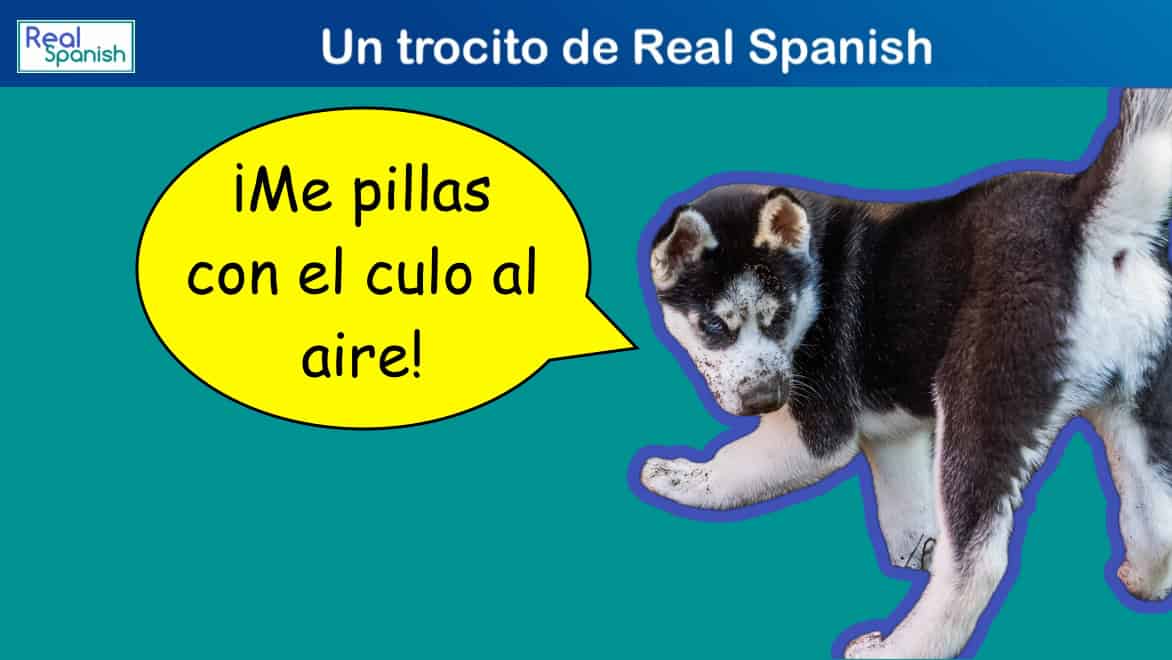
“Con el culo al aire”: Spanish expressions related to parts of the human body

First of all: The videos below are “Trocitos” from our YouTube channel. Un trocito is “a little bit” of something — usually something to eat. If you want to push yourself a bit, try reading the blog and viewing the videos in the Spanish version first. You can always come back here if you want to check a particular word or phrase. Just click on “English” or “Español” in the menu above. The first video below is part of a complete lesson in our ebook “Spanish for Perfectionists No. 2”. See below for more information about our ebooks and a free sample lesson. You’ll also find a bonus video featuring estirar la pata, por los pelos, and more.   Hi. I’m Elizabeth, from Real Spanish, and a keen learner of Spanish, like you. I’ve always been fascinated by how languages use the human body to express everything from mood and attitude to honesty and betrayal. Think of the expression “to put your foot down” in English. Spanish is full of such expressions. The first time I heard someone talk about a politician who’d been pillado con el culo al aire — literally “with their backside/arse/ass in the air” — I guessed from the context that it was something like “caught with their pants/trousers down” (caught out in an embarrassing or scandalous situation). I loved the image. That’s the thing about body part idioms in Spanish: they’re vivid, memorable, and often very funny. Once you know them, you start hearing them everywhere. Con el culo al aire is often used in conversations about corrupt politicians or badly-behaved celebrities. Every country has them! In this video, our virtual teacher Celia introduces several expressions with parts of the body. Some are perfectly polite in any situation, while others are a bit vulgar. But they’re all real Spanish, used by native speakers every day, so it’s definitely worth knowing what they mean, even if you choose not to use them yourself! Why not start your own collection of Spanish expressions? I keep a running list, and I add to it whenever I hear something new: in podcasts, films, or just chatting with native speakers. The key is to note them in context, so you remember how they’re actually used. WordReference.com is brilliant for this: it gives you real examples, not just definitions. All the best for your adventures in Spanish, Elizabeth from Real Spanish   The video: “Con el culo al aire”: Spanish expressions related to parts of the human body In this video you’ll hear these Spanish idioms that are common use in everyday conversations: dar la cara levantarse con el pie izquierdo dormir a pierna suelta estar hasta las narices / la coronilla / el moño / los cojones tener la lengua muy larga dejar (or pillar) a alguien con el culo en el aire lamerle el culo a alguien   English transcript Hello! At Real Spanish we’re creating a series of mini-lessons on expressions that refer to parts of the human

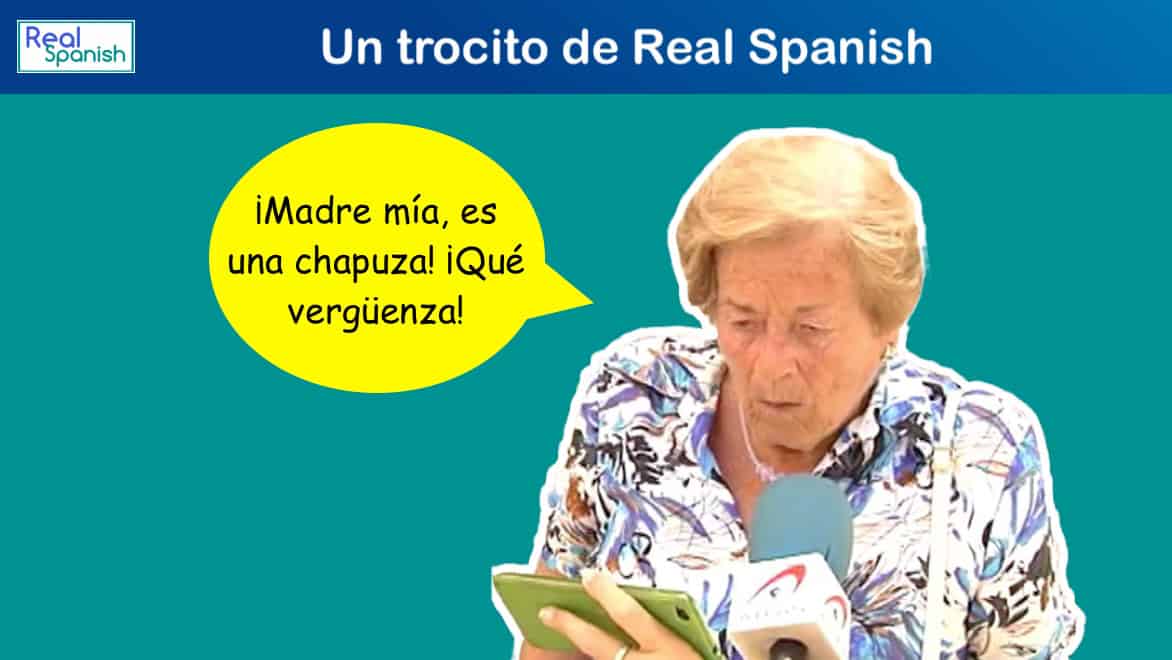
Un trocito de Real Spanish | “¡Qué vergüenza!": A Spanish art disaster

First of all: This video is one of our “Trocitos de Real Spanish” — short clips from our Spanish lessons to help you get used to real, everyday Spanish. A trocito literally means “a little piece” of something — usually something you can eat, like un trocito de queso (“a little piece of cheese”). This particular one is a preview of the full lesson ¡Es una chapuza!, from our course Español con noticias y documentales 1: Entrevistas y reportajes.   Hi there! I'm Elizabeth from Real Spanish, and like you, I'm passionate about learning Spanish. This video is all about Spain’s artistic heritage — and what happens when a restoration goes so badly wrong that it becomes a national embarrassment. Some of these stories were so shocking that they even made the news in other countries. And there’s more! You’ll also come across one of the most famous Spanish “false friends”: embarazada does not mean “embarrassed”... although you probably already knew that!   Click on the image to view the video.   Transcript: Download the PDF Note: This transcript has been slightly updated to reflect our current courses and resources, so the video may differ slightly from the text. We recommend listening to the audio first with the transcript, then without it, until you can make out every word. You can even repeat some sentences after the narrator, then record yourself and compare your pronunciation with hers. Keep going until you really do sound better.   Bonus: update on this story The world's most famous restoration chapuza happened in 2012, in the town of Borja, near Zaragoza. Cecilia Giménez, a local resident, took it upon herself to restore a 19th-century fresco titled Ecce Homo, painted by Elías García Martínez, in the Sanctuary of Mercy church. The result — Christ's face turned into something resembling a hairy monkey — went viral worldwide under the nickname Mono Cristo (“Monkey Christ”). Cecilia Giménez died on 31 December 2025, at the age of 94. But against all odds, her botched restoration had a happy ending: over 150,000 tourists have visited Borja to see the fresco for themselves, a small museum dedicated to the story opened in 2016, and she herself went on to exhibit 28 of her own paintings in the town. You can read the full story at The Art Newspaper. Links to related articles La leyenda de San Jorge y el dragón How 'Monkey Christ' brought new life to a quiet Spanish town 10 restauraciones de edificios en España que todos lamentan y ya no tienen vuelta atrás Botched Spanish statue that went viral is lovingly unrestored Spain’s latest ‘Ecce Homo’: how a botched restoration made global headlines Spanish statue bodge-up is a new rival to Borja's Monkey Christ Frequently asked questions What does una chapuza mean? It's a colloquial word for a shoddy, badly-done job — especially building or DIY work. According to the RAE, a chapuza is “work done badly and without care” (RAE's own gloss, translated here). Is avergonzado

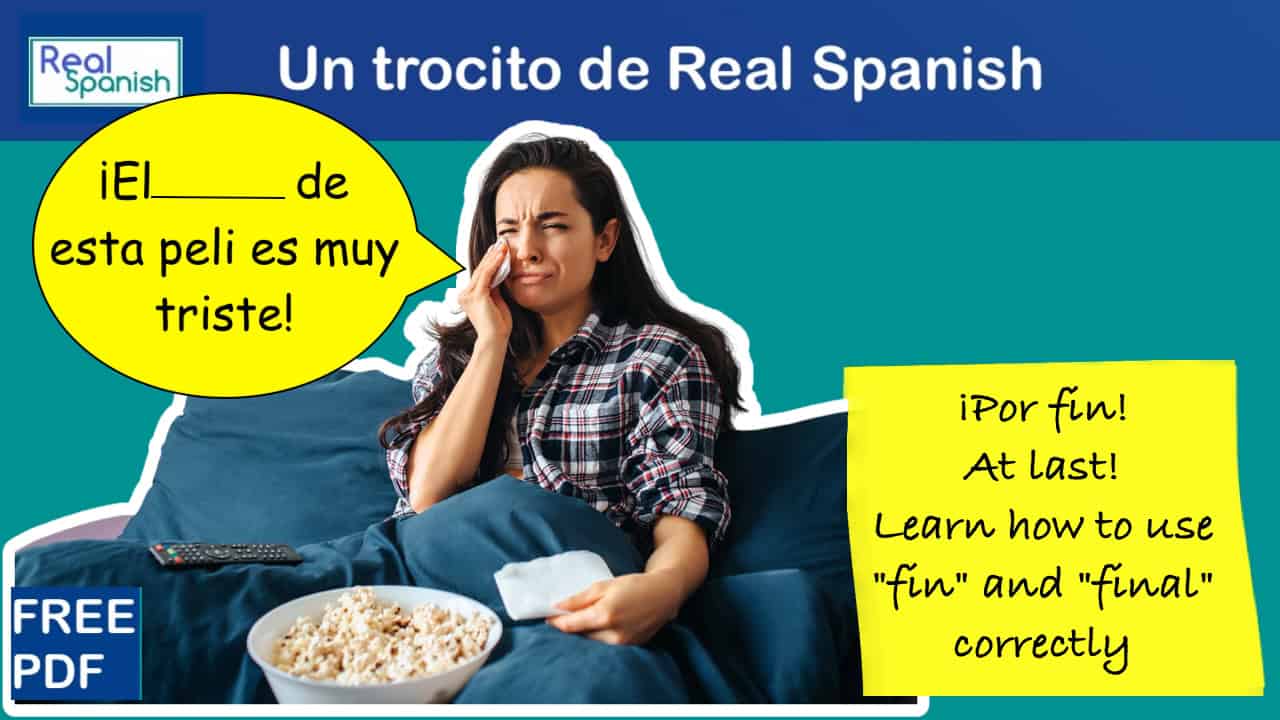
¡Por fin! At last! We help you to use «fin and «final» correctly.

  The video above explains some uses of «fin» and «final». The English transcription is below. If you just want to listen to the audio, you can find it on Soundcloud.  ¡Hi, and welcome to Real Spanish!   Do you still have trouble with «fin» and«final»? Do we say  «el fin» or «el final» of a movie? The first thing you need to know is that «fin» has three differen meanings. It can mean the end of something,  such as the end of the week, («el fin de semana») or, more colloquially, «el finde»). For example: «Este finde vamos a la playa». It can also mean the objective or motive for some action, such as, «El fin de su viaje era visitar a su madre». We use the connectors  «a fin de» or «con el fin de» with the meaning of «para». For example: «Estoy estudiando inteligencia artificial, a fin de prepararme para lo que venga en el futuro». «Se ha aprobado una nueva ley con el fin de limitar los precios del alquiler». But «fin» can  also mean a limit or border, as in «Esta línea representa el fin del terreno del parque». The word«final» also means «la parte final de algo», and in this case «fin» and «final» are interchangeable. Look at these examples: «Todos estamos rogando por el fin/el final de la guerra». «No consigo llegar a fin/final de mes». However, why do we usually say, «el final del libro» instead of «el fin del libro»? Well. it's because «el fin del libro» could be interpreted as the aim or objective of the book. Ah, and another difference: «final» can be an adjective as well as a noun, whereas «fin» is only a noun.  For example: «París fue el destino final de nuestro viaje». Y ahora algunas expresiones útiles: Por fin (at last) Al final (in/at the end) A/para /hasta finales de (at/by/until the end of...) Well, the aim of this vidoeowas to explain some uses of  «fin» and «final». And now we've come to the end. Bye for now!   Please leave us a comment, a question, or a suggestion below: we’d love to hear from you! Follow us on YouTube so you never miss our Trocitos de Real Spanish. You can also participate in our Community page on YouTube.  You'll find short quizzes, surveys, and quick explanations of vocabulary or grammar points.   Enjoy your Spanish with us! Click here to learn more about all our great materials.  Real Spanish: online Spanish courses and mini-lessons for people who are serious about improving their Spanish

Me importa un huevo

  This is a preview of our mini-lesson about colloquial Spanish expressions with the word «huevo». Some expressions with «huevos» are quite vulgar, because the word can also refer to "testicles" or "balls". If you only want to listen to the audio, you can find it on Soundcloud.  Hi! Today I’ll explain some colloquial uses of the word «huevo». Some of these expressions are quite vulgar, because in colloquial language «huevos» can mean “testicles” or “balls”, so be careful how you use them! Have you heard the expression «Me importa un huevo»? It means “I don’t care” or “I don’t give a shit.” In Mexico «a huevo has two meanings, depending on the context. It can be a strong yes, or the equivalent of “You bet!” For example, «¿De verdad vas a aceptar ese trabajo? Tendrás que viajar mucho». (Are you really going to accept that job? You’ll have to travel a lot.) «A huevo, no puedo perderme tal oportunidad.» (You bet I am, I’m not going to miss such an opportunity.) It can also mean «pase lo que pase» (no matter what). For example, «Tengo que terminar este proyecto para el viernes, a huevo» (I have« to finish this project by Friday, no matter what (or, come hell or high water). In Spain, «a huevo» means «a tiro» or «alcance» (it’s easy, a piece of cake, a walk in the park). For example, «Te has preparado muy bien la entrevista y ya conoces al jefe, vas a conseguir el trabajo seguro, lo tienes a huevo» (You are well prepared for the interview and you already know the boss, so it’s a piece of cake for you). There are so many expressions with «huevo» that we have created a mini-lesson on the topic. It consists of: A video An annotated transcription A set of grammar notes A couple of interactive exercises Click below to learn more. OK, that’s all for today. Bye for now!   If you liked this video, you will enjoy our complete mini-lesson on the topic. . You can get five minis for the price of four! Click here to learn more.  Follow us on YouTube  soyou don't miss any of our Trocitos de Real Spanish!   Get in touch. We'd love to hear from you. You can leave us a comment, a question or a suggestion. You can also participate on our You Tube Community Page. You'll find quizzes, surveyas and interesting points of vocaulary and grammar.   Improve your Spanish with us. Click here to learn more about all our materials. Real Spanish: Courses and mini-lessons online for people who are serious about improving their Spanish.