Learn Spanish Through Hispanic Culture

Do you know when to shake hands or kiss cheeks in Spain — and which cheek goes first? Do you know the key differences between Peninsular and Latin American Spanish, such as tú vs vos, or the way “z” and “c” are pronounced in different countries and regions? Do you know the origin of expressions like “como Pedro por su casa”, or why Spain’s Christmas lottery is one of the most eagerly talked-about events of the year?

Cultural knowledge is just as important as vocabulary and grammar when you’re learning a language. Without it, even grammatically perfect Spanish can leave you puzzled by what people are talking about.

In this section, we explore Spanish customs and traditions, the fascinating differences between Spain and Latin America, and the cultural references that make conversations come alive. Some of these posts include one of our YouTube videos, Trocitos de Real Spanish. We keep adding new content — had any cultural adventures in Spanish lately? Let us know what topics you’d love us to cover next!

¡Explora la cultura hispánica con nosotros!

Elizabeth from Real Spanish

Seasonal Spanish | Flores, dulces y calaveras: How We Celebrate All Saints’ Day and the Day of the Dead

First of All First of all, if this is your first visit to this corner of the blog: welcome to Seasonal Spanish (Español de temporada), our series of video lessons on the big festivals and special days of the Spanish-speaking world, such as Nochevieja, Carnaval, Semana Santa and el Día del Trabajo. The lessons are designed for intermediate to advanced learners, with a focus on the Spanish people really use and on the grammar points that come up in the video. Each video comes with its own student PDF —annotated transcript, grammar notes and links to activities— as well as notes for teachers. This is the first of two lessons about 1 November. In this one we look at the traditions: the flowers, the sweets, the theatre and the Mexican ofrendas. In the second, ¡Por encima de mi cadáver! (Over my dead body!), we’ll see how people talk about death in Spanish, with formal and informal expressions, and even a few funny ones. By the way, depending on your level, you might like to read this post in English first and then challenge yourself with the Spanish version: just click “Español” at the top. My 1 November in Barcelona In autumn, Barcelona smells of roasted chestnuts. From mid-October, the castañeras set up their stalls in the streets, selling hot chestnuts and roasted sweet potatoes in paper cones, and the pastry shop windows fill up with panellets. On the eve of All Saints’ Day, lots of families and groups of friends get together to celebrate the castanyada: chestnuts, sweet potatoes, panellets and, for the grown-ups, a little glass of muscatel. My favourite part is the chestnuts. And, as everywhere in Spain, on the 1st many families take flowers to the cemetery. For some it’s a religious day; for others, simply a day to remember their loved ones. I’ve never gone myself, because my relatives who have passed away aren’t buried in Barcelona. Panellets, the classic sweet of the castanyada Something That Might Surprise You: 1 November Isn’t the Day of the Dead This is a very common mix-up, even among Spanish speakers. 1 November is All Saints’ Day (el Día de Todos los Santos), when the Catholic Church remembers all the saints, known and unknown. The day the Church dedicates to remembering everyone who has died is actually 2 November: All Souls’ Day, el Día de los Fieles Difuntos, or simply el Día de Difuntos. But because in Spain the 1st is a public holiday and the 2nd usually isn’t, families go to the cemetery on the 1st, and in practice the two dates have merged into one. In Latin America, on the other hand, 2 November matters much more: in Ecuador, for example, the big day is el Día de los Difuntos, and in Mexico el Día de Muertos covers both dates. A vocabulary tip: un difunto or una difunta is a person who has died (“the deceased”). Sugar skulls… and a Halloween pumpkin in the background And Halloween? It
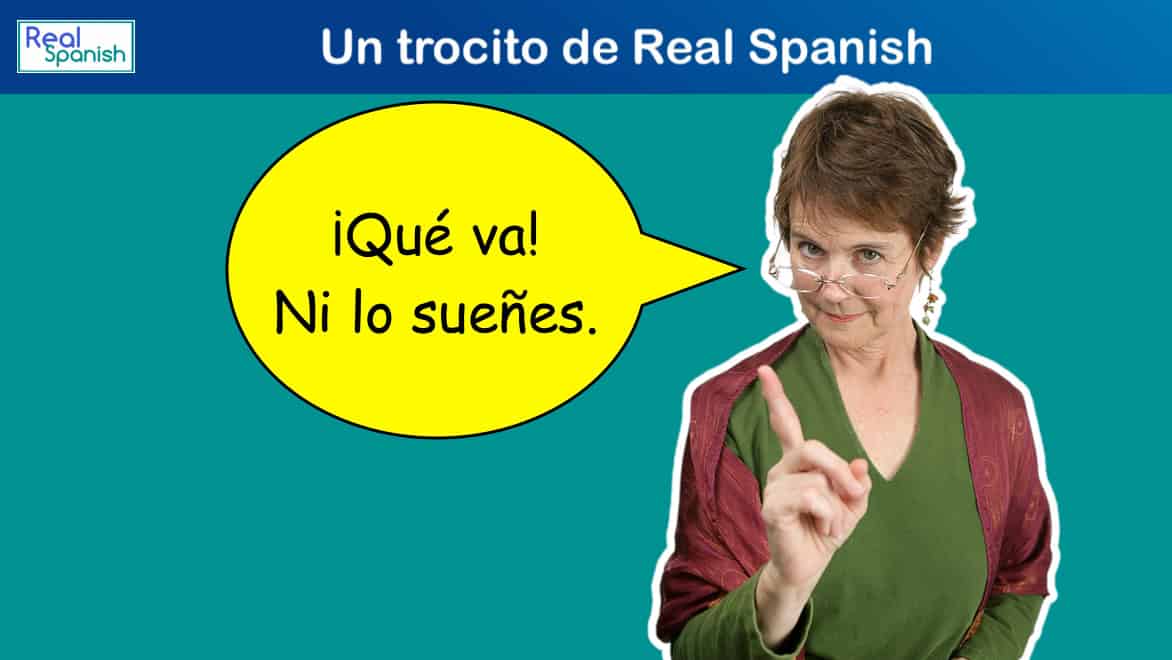
Woman scoding, wagging finger: "¡Qué va! ¡Ni lo sueñes!"

Un trocito de Real Spanish | "Pero ¿Qué fiesta? ¡Ni qué niño muerto!" and other great ways to give a firm "no!" in Spanish

First of all:  Do you know the expression !Qué va!? We explain it in this video, along with other great ways to give a firm "No!" If you want to push yourself a bit, try reading this intro in the Spanish version first. You can always come back here if you want to check a particular word or phrase. Just click on "English" or "Español" in the menu above.  By the way: Un trocito is a small piece or bit of something, as in Un trocito de chocolate. This Trocito de Real Spanish is part of a complete lesson in our ebook Spanish for Perfectionists No. 1. See below for more information about our ebooks and a free sample lesson.    Hi. I’m Elizabeth, from Real Spanish, and a keen learner of Spanish, like you. I collect interesting and useful Spanish phrases, sometimes several in one day— in a movie, a newspaper, a podcast, or just a normal day-to-day interaction with Spanish speakers— it’s become a kind of hobby. I live in Barcelona, so I have plenty of source material. Spanish is wonderfully expressive and you can add loads of colour and authenticity to your own speech if you have a good repertoire of useful vivid phrases you can use in real conversations with native speakers. They really help to string your ideas together and express what you really mean. Why not develop your own collection of useful expressions? If you are not surrounded by Spanish speakers every day, how about a language partner online? We have a blog post about that, in English or Spanish. Or you can watch films and TV shows. Did you know that on YouTube and Netflix you can slow down the audio playback for the difficult bits?  Don’t know how? We have a video for that! Watch on your computer but keep WordReference.com open on your phone or tablet  (or any other combination of two screens, to save you switching back and forth between apps). It’s the best resource I have found for colloquial expressions. Professional translators use it. The video below explains some great expressions that you can use in real conversations with native speakers to reject an idea, a proposal or a request. I’m sure you already know what ¡Qué va! means. You could translate it as “No way”. But I bet this one sounds strange: ¡Ni qué niño muerto! literally means “Not even a dead child”. Sounds grim, right? We explain its curious origin in the video below, so let’s get on with it. All the best for your adventures in Spanish, Elizabeth from Real Spanish   The video: Click the image to view on YouTube   Transcript: Download the PDF Sign up to download the PDF   And a few more for your collection: Here are a few more examples of these expressions in context. We've also added four more expressions you can use to reject a request, a suggestion, or an idea. Of course you can just say no, but your speech

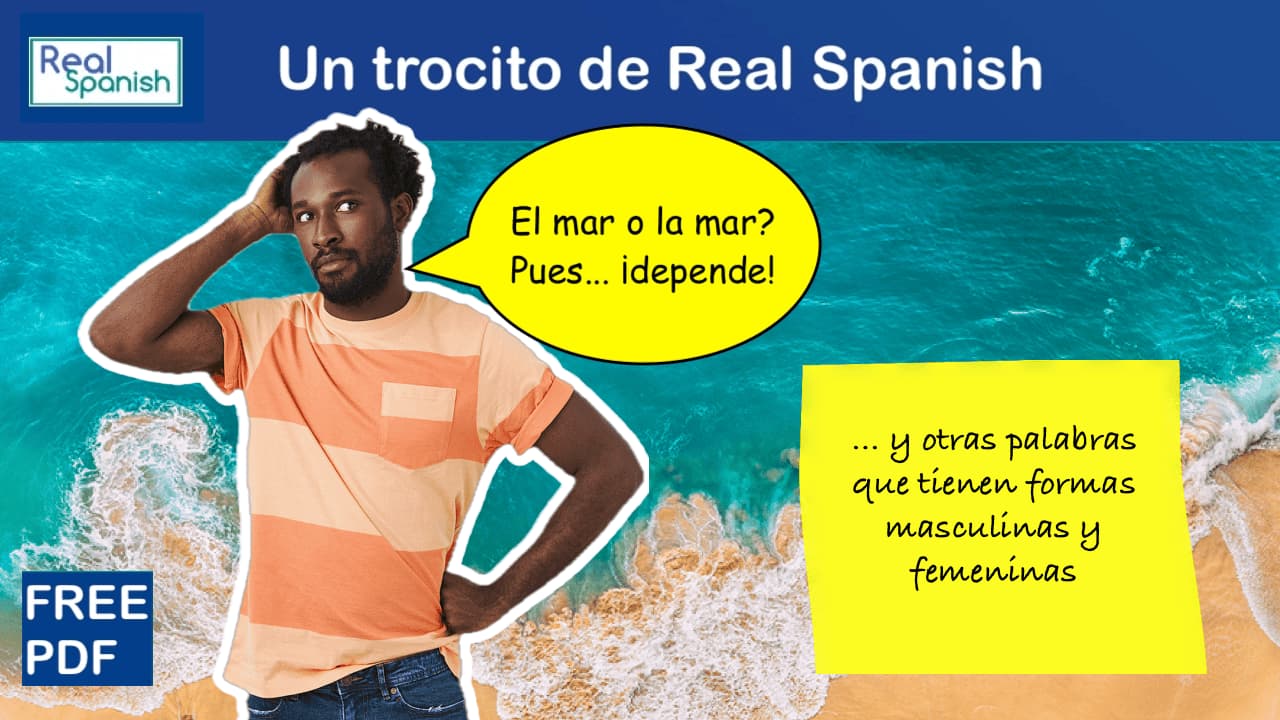
Man on seahsore looking puzled. Speech bubble: "¿El mar o la mar? Pues... ¡Depende!"

Un trocito de Real Spanish | “El mar” or “la mar”? Well, that depends!

“El mar” or “la mar”? Well, that depends!   First of all: This video is one of our “Trocitos de Real Spanish” (Little Bits of Real Spanish). A trocito is a small amount of something — usually something to eat, like a trocito of chocolate! This particular one is a preview of a full lesson from our ebook Spanish for Perfectionists No. 1. Below you'll also find a link to a free sample lesson from Spanish for Perfectionists No. 2.   Hi there! I'm Elizabeth from Real Spanish, and like you, I'm passionate about learning Spanish. After all these years of studying, I thought I'd pretty much figured out which nouns are masculine and which are feminine. What a surprise it was to discover that el mar and la mar both exist! Same word, two genders, and a nuance of difference between them that's worth knowing. The video below explains when to use el mar and when to use la mar, plus several really cool expressions with the word mar that native speakers use all the time. Heads up: a couple of them are a little vulgar!   To view the video, click on the image. Transcript: Download the PDF       How to get the most out of the video and transcript The transcript is the exact text of the video script. Read it before watching the video if you like, but always read it afterwards while you listen to the audio, several times. As you listen, pay attention to intonation, phrasing, pace and the individual sounds of Spanish. Then choose a sentence or two to read aloud in time with the speaker, imitating them as closely as you can. Later you can record yourself and compare your speech with theirs. This procedure works well: Listen and repeat several times, imitating the speaker as closely as possible. When you’re ready, record yourself. Listen to the speaker again and immediately listen to yourself. Repeat until you’re satisfied that your pronunciation is closer to the speaker’s. Doing this several times over a few days, and several more times over the next few weeks, will help tune your ear to Spanish and make your own speech easier to understand. It’s unlikely that adults who start learning a language after puberty will end up with a native-speaker accent, but with persistence you can sound more natural and less hesitant, feel more confident, speak more fluently and, above all, be understood. You have to do the work! This method is probably more work than you expected... but repetition is essential for learning a language and developing fluency. There are no shortcuts, but we promise you’ll enjoy learning with our engaging video lessons. Bonus: a poem, and a few more expressions El mar. La mar. El mar. ¡Sólo la mar! ¿Por qué me trajiste, padre, a la ciudad?   Rafael Alberti, Marinero en Tierra (1924) (“The sea. The sea. The sea, only the sea! Father, why did you bring me to the city?”)  

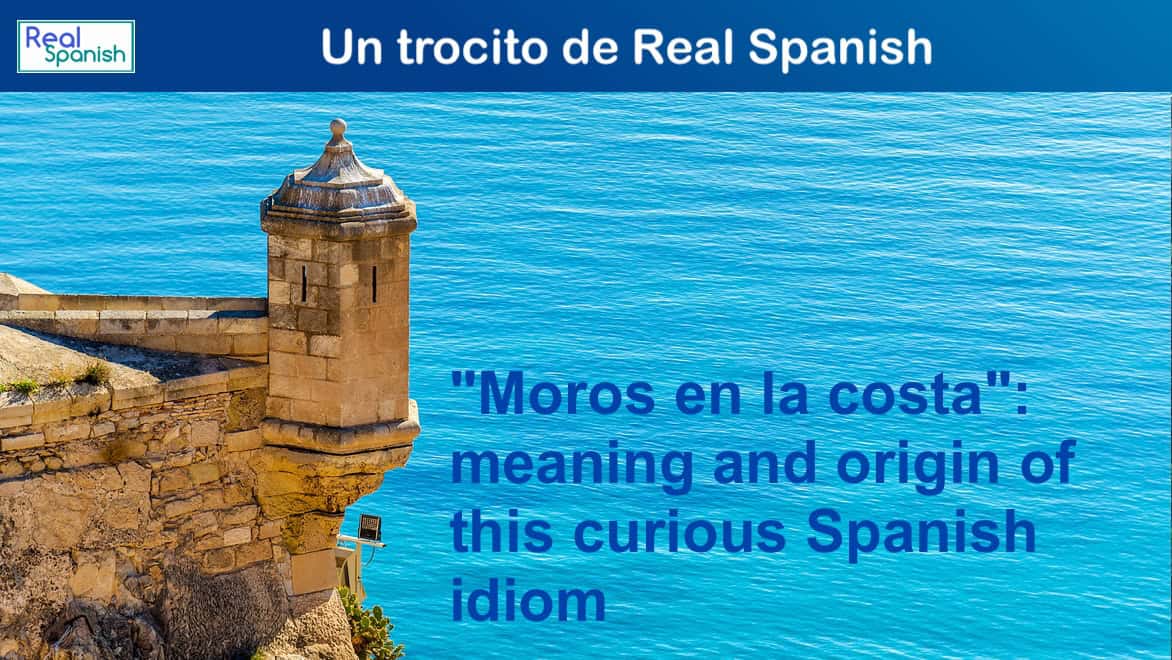
Un trocito de Real Spanish | "Moros en la costa": meaning and origin of this curious Spanish idiom

First of all: This is the English version of the transcript of one of our "Trocitos de Real Spanish". Un trocito is a little bit of something (usually something to eat). This Trocito is a preview of our online Spanish course “Español con noticias y documentales 2: La historia de tres regiones bilingües de España”. The additional learning materials referred to in the video are available in the complete course. You’ll find a link to this and all our courses below. If you want to push yourself, try reading the Spanish version of this blogpost and video transcript first (just click on “español” in the menu above) — then come back here to check anything you're not sure about.   Hello! I’m Elizabeth, from Real Spanish, and a dedicated student of Spanish. I love learning new expressions in Spanish. As you know, most of them can’t be translated literally because they are based on the culture and history of the Spanish-speaking world. Some are local to a particular country or region. Some are so interesting that they deserve a video all to themselves! If you’ve spent any time with Spanish speakers, you’ve probably heard someone suddenly lower their voice and mutter ¡Moros en la costa! — maybe when the boss walks in, or when a sibling appears at an inconvenient moment. But where does this expression come from, and what do Moors have to do with it? The story takes us back to medieval Spain, a network of coastal watchtowers (torres vigía), and a very real danger that kept entire villages on permanent alert for centuries. The video below explains the origin of ¡Moros en la costa!, one of the most colourful idioms in everyday Spanish, which can be traced back to its historical roots: the constant raids by North African Muslims along the Mediterranean coast, and the very real danger that kept coastal villages on permanent alert. It also touches on a related expression, prometer el oro y el moro, and looks honestly at why both expressions carry some cultural baggage worth knowing about. Wishing you all the best for your adventures in Spanish, Elizabeth from Real Spanish Click on the image to view the video   Download the transcript Interesting! That’s the magic of expressions like this one — they’re living fossils of the culture that created them. Every time a Spanish speaker whispers ¡Moros en la costa! across a dinner table, they’re unknowingly echoing the voice of a medieval lookout scanning the horizon for sails.   If you enjoyed this video, you'll like a related video featuring the expression “Como Pedro por su casa”, another popular Spanish saying based on historical events. You might also be interested in the  complete course “Español con noticias y documentales 2: Tres regiones bilingües de España”. Visit us to learn more and try some free sample lessons. If you like learning expressions like this, check out our YouTube playlists. Ready for something more demanding? Take a look at our online Spanish

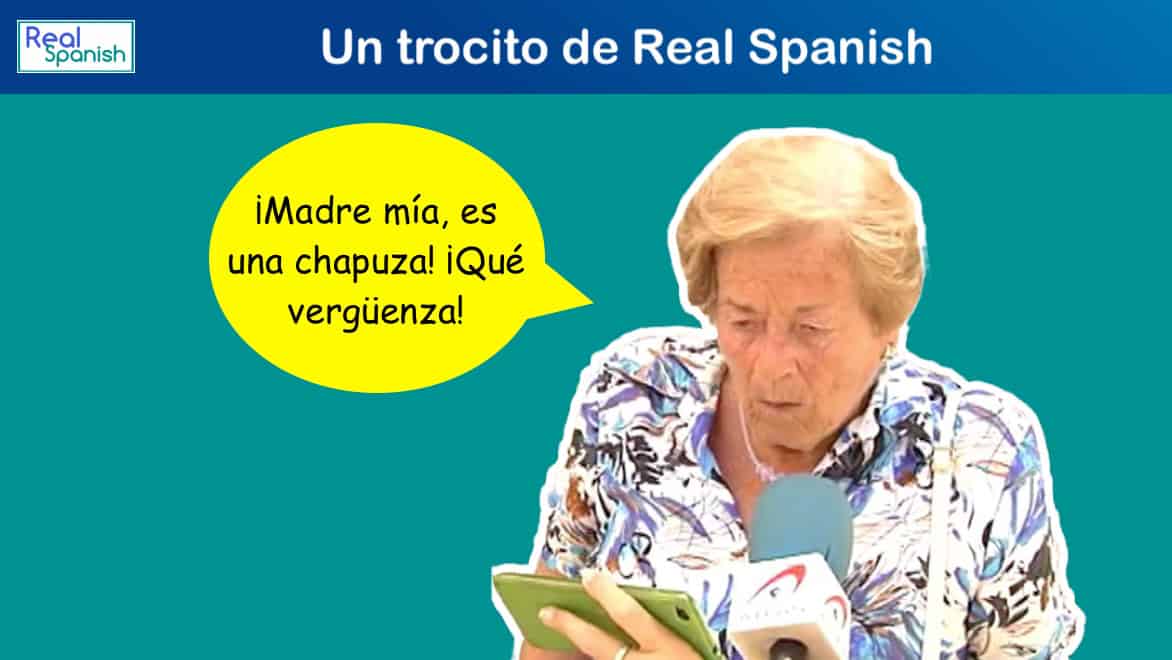
Woman looking shocked at an image on a mobile phone. Text in speech bubble: "Qué vergüenza! ¡Es una chapuza!"

Un trocito de Real Spanish | “¡Qué vergüenza!": a notorious "chapuza" in Spanish art

First of all: In this video you'll learn the word chapuza and other words and expressions related to works of art and Spain's artistic heritage. This video is a preview of the full lesson ¡Es una chapuza!, from our course Español con noticias y documentales 1: Entrevistas y reportajes. This preview is one of our “Trocitos de Real Spanish” — short clips from our Spanish lessons to help you get used to real, everyday Spanish. A trocito literally means “a little piece” of something — usually something you can eat, like un trocito de queso (“a little piece of cheese”).    Hi there! I'm Elizabeth from Real Spanish, and like you, I'm passionate about learning Spanish. One of my first visits to Spain was a two-week bus tour highlighting Spain's most famous buildings: churches, art galleries, museums, castles and famous palaces. It was gorgeous but exhausting. I now live in Barcelona, where the  Modernista buildings of Gaudí and others have also left a lasting heritage to the city. When people ask why I left Toronto to live here, I always include the art and monuments of Spain as one of the major attractions. This video is all about Spain’s artistic heritage — and what happens when a restoration goes so badly wrong that it becomes a national embarrassment. Some of these stories were so shocking that they even made the news in other countries. Talk about embarrassing — ¡qué vergüenza, de verdad! And there’s more! You’ll also come across one of the most famous Spanish “false friends”: embarazada does not mean “embarrassed”... although you probably already knew that! We'll also explain some adjectives that change their meaning according to whether they are used with ser or estar. Yes, no matter how long we have been studying Spanish, these two verbs keep coming back to bite us.   Click on the image to view the video.   Transcript: Download the PDF Note: This annotated transcript has been slightly updated to reflect our current courses and resources, so the video may differ slightly from the text. We recommend listening to the audio first with the transcript, then without it, until you can make out every word. You can even repeat some sentences after the narrator, then record yourself and compare your pronunciation with hers. Keep going until you really do sound better.   Bonus: update on this story The world's most infamous restoration chapuza happened in 2012, in the town of Borja, near Zaragoza. Cecilia Giménez, a local resident, took it upon herself to restore a 19th-century fresco titled Ecce Homo, painted by Elías García Martínez, in the Sanctuary of Mercy church. The result — Christ's face turned into something resembling a hairy monkey — went viral worldwide under the nickname Mono Cristo (“Monkey Christ”). Cecilia Giménez died on 31 December 2025, at the age of 94. But against all odds, her botched restoration had a happy ending: over 150,000 tourists have visited Borja to see the fresco for themselves, a small museum

Un trocito de Real Spanish: «Cómo Pedro por su casa»

First of all: If you want to push yourself, try reading the Spanish version of this intro first. You can always click in the menu above to come back here and check the meaning of a word or phrase.   Hi everyone! I’m Elizabeth from Real Spanish, a dedicated Spanish student. I’ve been living in Spain for over a decade and I’m still learning new words and expressions. In fact I have a document where I record at least one a day, gathered from a newspaper, a Netflix show or a normal everyday conversation. Today’s Spanish idiom, "Como Pedro por su casa", is one of them. Sometimes a new phrase is so intriguing that I end up making a video, one of our  "Trocitos de Real Spanish", about its origin and meaning. Un trocito is a little bit of something, like a little piece of cheese. This trocito  is also a preview of our course "Español con noticias y documentales 2: La historia de tres regiones bilingües de España".  So what does “Como Pedro por su casa” mean? It’s an idiomatic expression that means acting as if you own the place (making yourself very much at home somewhere, or taking liberties you probably shouldn’t). But the really fun part is where the expression comes from. The origin is medieval and surprisingly dramatic — watch the video to find out the full story! Wishing you all the best for your adventures in Spanish, Elizabeth from Real Spanish   Download the transcript     Would you like to see a related Trocito? It's about the expression No hay moros en la costa, another popular Spanish saying that comes from the history of the country. If you like learning expressions like this, check out our YouTube playlists. On our website you can find lots of other free video lessons: some with transcripts, vocabulary and grammar notes, and activities to practice and test what you’ve learned. Hope to see you there! Ready for something more demanding? Take a look at our online Spanish courses.   

This site is registered on wpml.org as a development site. Switch to a production site key to remove this banner.