
First of All
Before anything else, if this is your first visit to this corner of the blog: welcome to Seasonal Spanish, our series of video lessons about the great festivities and special days of the Spanish-speaking world, like New Year's Eve, Carnival, Labour Day, Holy Week and more. These lessons are aimed at intermediate-advanced learners, packed with the colloquial expressions people actually use in everyday speech: things like partirse el lomo, pasarlo pipa or no dar palo al agua. We also focus on the grammar nuances that come up in the video. Every video comes with its own student PDF—annotated transcript, grammar notes and links to activities—plus notes for teachers.
By the way, this entry and the video carry quite a bit of specialised vocabulary, so depending on your level, you might prefer to read this entry in Spanish first: click “Español” above. But I'd encourage you to come back here afterwards to read it in English too—it's always a good way to check your understanding and then stretch your Spanish further.
My Holy Week: from Barcelona to Seville
I live in Barcelona, so my own experience of Semana Santa is, let's say kindly, the quiet version. There are processions here, yes, but nothing like the scale of Andalusia: the towering pasos, the costaleros sweating under the weight of the image, saetas sung from a balcony, the total silence of a packed street. That's Seville, and it's Holy Week with a capital H.
I'll admit I've never actually been in Seville during Holy Week itself. But I did visit once, a couple of weeks before Easter, wandering around the Santa Cruz neighbourhood. And I saw one of those scenes that sticks with you: a group of little boys, no more than eight or nine years old, playing at being costaleros.
They'd improvised a paso out of a small table, covered it with a tablecloth to stand in for the cloak, put a couple of religious figurines on top, and took turns carrying it on their shoulders down the pavement, dead serious, copying the slow, swaying walk of the real cofrades. Nobody had asked them to. It was simply, for them, as natural a game as playing football. It's a shame I don't have a photo, but you can picture the scene. That's when it really hit me how deeply Holy Week runs through the emotional fabric of a city like Seville—even for people still in short trousers.
Something that might surprise you: the capirotes
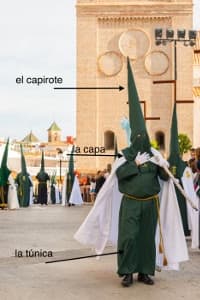
If you're from North America and you see a Holy Week procession for the first time, there's something that's probably going to unsettle you: the capirotes. Those tall, pointed hoods, with the nazareno's face covered beneath the cloth, can be unnerving, recalling—uncomfortably—the robes of the Ku Klux Klan. Even more so if you are black. It's an entirely understandable reaction, and I'd rather address it head-on than pretend it doesn't exist. The short answer is: no, they're not connected. Spain's confraternity capirote is far older, and grows out of a completely different impulse. Its origin lies in the Catholic penitential tradition: penitents covered their faces precisely to keep their act of faith anonymous, so that the gesture was one of humility before God rather than an occasion for pride or public recognition. |
 |
The Ku Klux Klan, in North America, adopted a similar silhouette—pointed hood, white robe—much later, and considerably later than most people assume: the original Klan of the 1860s didn't even have a uniform costume; the white, pointed look we recognise today wasn't standardised until the so-called “second Klan”, from 1915 onward. Its meaning, too, was the exact opposite: not concealing identity out of humility, but using anonymity and intimidation as a weapon of racial terror. Two histories that, through pure visual coincidence, have ended up colliding in the minds of a lot of people seeing a Spanish procession for the first time without that context.
I'm telling you this because it's exactly the kind of thing no grammar class will ever explain to you, and yet it can completely change how you experience—or how you hold back from asking about—your first Holy Week in Spain or elsewhere in the Spanish-speaking world.
Below you'll find the video, the PDFs and some extra content to round out what you know about this cultural phenomenon. ¡Felices Pascuas! (This is what you say on Easter Sunday.)
Solemne y alegre (Solemn and joyful): the video
The PDFs
The PDFs for this lesson (for students and teachers) are free for registered users. Register for free or, if you already have an account, log in: you’ll come straight back to this page.
Extra content
If you prefer, you can read this content in Spanish and challenge yourself with that version instead—click “Español” above. Or read this version first in preparation for reading the Spanish version.
Holy Week is a religious festival that lasts a week. It begins on Palm Sunday and ends on Easter Sunday. The dates change every year, depending on the full moon and the arrival of spring. During that week the streets fill with processions. |
 |
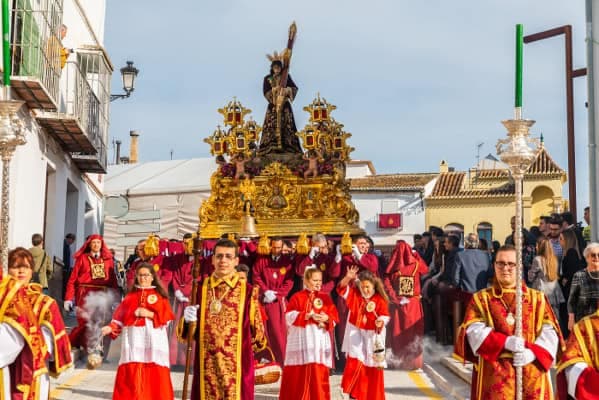
Every procession revolves around a paso: a wooden structure, often enormous, bearing religious figures of Jesus or the Virgin. It's carried on the shoulders of costaleros and costaleras, and accompanied by a marching band, along with nazarenos and penitents dressed in tunic, cloak and capirote in the colours of their brotherhood or confraternity. Nazarenos carry cirios—very large candles—and penitents carry crosses or chains around their ankles. |
 |
While we're on the vocabulary: here's what each piece of the nazareno's outfit is called. You'll see these same words again and again in any account or video about Spanish Holy Week. |
 |
In Andalusia, in southern Spain, this festival is experienced with an intensity that's hard to overstate. Some people get up at dawn or stay up all night just to see their favourite paso set out, and the town hall sets up paid seating along the streets the processions pass through. Those who don't sit watch standing, in silence, as a mark of respect. |
 |
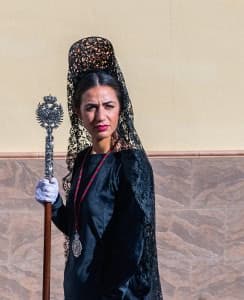
People also dress up a great deal for the occasion: some women wear a black dress with a mantilla—a veil held in place on the head with a peineta comb. Sometimes the procession stops beneath a balcony and someone sings a saeta, a flamenco song full of feeling, dedicated to the image passing by. |
 |
And since it's not all solemnity: during Holy Week people eat torrijas, a sweet made from bread fried in milk and egg and drizzled with honey—Spain's cousin to French toast. |
 |
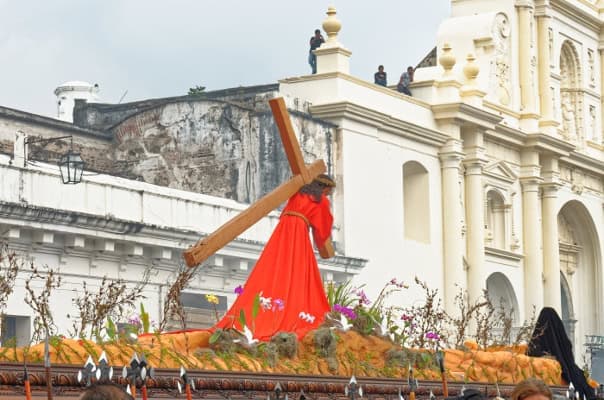
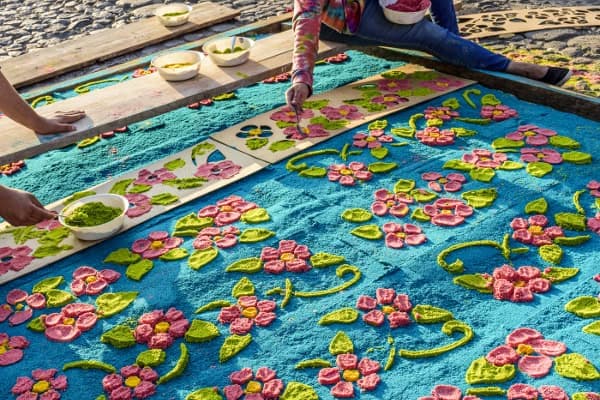
In Latin America, Holy Week is experienced with just as much passion, though every country has its own customs. In Guatemala the carpets are famous: genuine ephemeral works of art made from flowers, sawdust or coloured sand, covering the streets the procession is about to pass through—and which many locals help to create. |
 |
In Peru, Ayacucho stands out, where indigenous traditions intertwine with the Catholic religion. On Palm Sunday comes the Entrada del Chamizo: a parade of mules decked out in traditional embroidery, carrying dry branches that are burned the following Sunday, Easter Sunday, as a symbol of purification. |
|
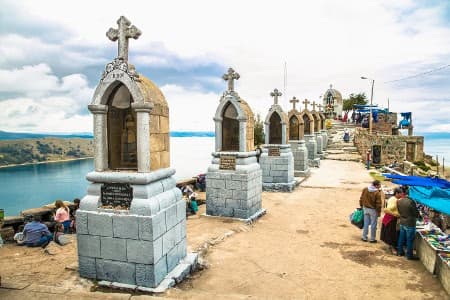
In Bolivia, a very curious custom is the Kespiyariña of Good Friday—the night on which, according to tradition, God is dead: small thefts between neighbours are tolerated, like making off with an animal, without anyone taking offence. That same weekend, thousands of people walk the roughly 150 kilometres separating La Paz from the sanctuary of Copacabana, on the shores of Lake Titicaca. |
 |
In Venezuela, the burning of Judas is celebrated: a cloth doll dressed in old clothes—sometimes made to resemble a political figure of the moment—with fireworks tucked inside. Before it's burned, it's common to throw stones at it, symbolically “hang” it, and hang satirical signs about current affairs on it. |
|
These are just a few examples: every corner of the Spanish-speaking world lives Holy Week in its own way.
If you'd like to keep exploring (in Spanish, no subtitles): a video about Holy Week in Latin America in general, two recordings of processions in Seville (here and here), an example of a saeta sung from a balcony, the Entrada del Chamizo in Ayacucho (Peru), more on the burning of Judas in Venezuela, and two videos of the effigy being burned (here and here).
Frequently asked questions about Semana Santa
Here are the answers to the most common questions about Holy Week, with references to historical and official sources.
What is Semana Santa?
It's the week that commemorates the passion, death and resurrection of Jesus Christ, celebrated throughout Spain and much of the Spanish-speaking world with processions, music and intense religious and social activity that varies a great deal from region to region. Since 2017 it has been recognised as Intangible Cultural Heritage of Spain by the Ministry of Culture.
When is Semana Santa?
It's a movable feast: it doesn't have a fixed date, because Easter Sunday always falls on the first Sunday after the first full moon of spring. So depending on the year, Holy Week can land anywhere between late March and late April.
Why do nazarenos wear the capirote in the processions?
The capirote covers the penitent's face so that their act of faith is anonymous—a gesture of humility practised by penitential confraternities since at least the 17th century (the Hermandad de San Juan de Letrán was the first to wear it finished in a point, according to Wikipedia). Around the same period, and within that same culture of public penance, the Inquisition also made those it condemned wear a sambenito and capirote, although that was a distinct use of the same garment.
Is the capirote related to the Ku Klux Klan?
No. They're two independent traditions, centuries apart. Spain's penitential capirote already existed in the 17th century; the white, pointed look associated today with the Ku Klux Klan wasn't standardised until the so-called “second Klan”, from 1915 onward—the original Klan, from the 1860s, didn't even have a uniform costume, according to the Anti-Defamation League (ADL). The resemblance is a late visual coincidence, not a shared origin.
Is Semana Santa the same everywhere in Spain?
Not at all. Seville and the rest of Andalusia experience a huge, highly theatrical Holy Week, with grand pasos and centuries-old confraternities; in cities like Barcelona the celebration is much more low-key and, for many residents, barely noticeable.
How is Semana Santa celebrated in Latin America?
Every country has its own tradition: the sawdust-and-flower carpets of Antigua, in Guatemala, are world-famous, as are the processions of Ayacucho, in Peru, declared Cultural Heritage of the Nation by the Peruvian Ministry of Culture in 2022. Broadly, they share the religious foundation with Spain, but each with a very distinct local identity.
What does “Semana Santa” mean?
It translates as Holy Week. It's the same celebration—the week leading up to Easter—whether it's experienced in Spain or anywhere else in the Christian world.
Still have questions? Leave us a comment below.
Keep exploring with us
Explore Hispanic culture with us! And if you've had your own Holy Week experience—in Spain or in Latin America—tell me about it in the comments: I love hearing about the cultural adventures you're having with Spanish.
We have more Seasonal Spanish video lessons, each with its own annotated transcript, grammar notes and activities. The easiest way to reach all the material—student PDF, teacher notes (group class) and teacher notes (individual class)—is through our Free resources (in English); once you've registered, you'll have direct access to the PDFs for the whole series, not just this lesson. You can also watch the rest of the Seasonal Spanish series on our YouTube playlist.
Real Spanish has other free resources too: videos, transcripts, vocabulary lists, and practice and quiz activities. Hope to see you there!
Feeling ready for something more demanding? You can try a couple of free lessons from our online Spanish courses.
Best wishes from Barcelona,
Elizabeth, from Real Spanish
Comments