
First of All
First of all, if this is your first visit to this corner of the blog: welcome to Seasonal Spanish (Español de temporada), our series of video lessons on the big festivals and special days of the Spanish-speaking world, such as Nochevieja, Carnaval, Semana Santa and el Día del Trabajo. The lessons are designed for intermediate to advanced learners, with a focus on the Spanish people really use and on the grammar points that come up in the video. Each video comes with its own student PDF —annotated transcript, grammar notes and links to activities— as well as notes for teachers.
This is the first of two lessons about 1 November. In this one we look at the traditions: the flowers, the sweets, the theatre and the Mexican ofrendas. In the second, ¡Por encima de mi cadáver! (Over my dead body!), we’ll see how people talk about death in Spanish, with formal and informal expressions, and even a few funny ones.
By the way, depending on your level, you might like to read this post in English first and then challenge yourself with the Spanish version: just click “Español” at the top.
My 1 November in Barcelona
| In autumn, Barcelona smells of roasted chestnuts. From mid-October, the castañeras set up their stalls in the streets, selling hot chestnuts and roasted sweet potatoes in paper cones, and the pastry shop windows fill up with panellets.
On the eve of All Saints’ Day, lots of families and groups of friends get together to celebrate the castanyada: chestnuts, sweet potatoes, panellets and, for the grown-ups, a little glass of muscatel. My favourite part is the chestnuts. And, as everywhere in Spain, on the 1st many families take flowers to the cemetery. For some it’s a religious day; for others, simply a day to remember their loved ones. I’ve never gone myself, because my relatives who have passed away aren’t buried in Barcelona. |
 Panellets, the classic sweet of the castanyada |
Something That Might Surprise You: 1 November Isn’t the Day of the Dead
| This is a very common mix-up, even among Spanish speakers. 1 November is All Saints’ Day (el Día de Todos los Santos), when the Catholic Church remembers all the saints, known and unknown. The day the Church dedicates to remembering everyone who has died is actually 2 November: All Souls’ Day, el Día de los Fieles Difuntos, or simply el Día de Difuntos.
But because in Spain the 1st is a public holiday and the 2nd usually isn’t, families go to the cemetery on the 1st, and in practice the two dates have merged into one. In Latin America, on the other hand, 2 November matters much more: in Ecuador, for example, the big day is el Día de los Difuntos, and in Mexico el Día de Muertos covers both dates. A vocabulary tip: un difunto or una difunta is a person who has died (“the deceased”). |
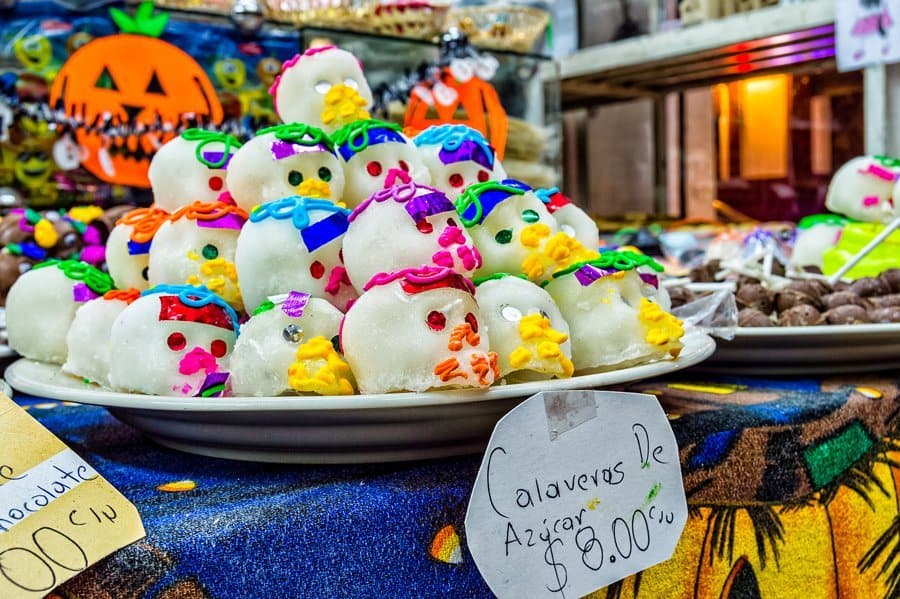 Sugar skulls… and a Halloween pumpkin in the background |
And Halloween? It arrived in Spain a few decades ago, thanks to American films and TV, and now there are fancy-dress parties on the night of 31 October in many cities. In Barcelona you’ll see young people dressed up as ghosts, witches, monsters and famous characters, real or fictional. And lately ¡truco o trato! (trick or treat) has been catching on. In Galicia, meanwhile, they celebrate Samaín, a festival of Celtic origin that marked the end of the harvest. People hollow out pumpkins, carve a face in them and light them with a candle inside; in the Rías Baixas these pumpkins are called calacús. The tradition has made a strong comeback over the last thirty years.
Below you’ll find the video, the PDFs and plenty of extra content that didn’t fit in the video.
Flores, dulces y calaveras: The Video
[YouTube video: link pending]
The PDFs
Student PDF [link pending]
Teachers’ PDF: group class [link pending]
Teachers’ PDF: one-to-one class [link pending]
Bonus Material
I had so much material on this topic that it didn’t all fit in one video; in fact, I had to split it into two (see below for the link to the second one). Even so, there was so much interesting material left over that I decided to share it with you here. If you like, you can read it in English first and then challenge yourself with the Spanish version: just click “Español” at the top.
More Expressions About Death
In lesson 2, ¡Por encima de mi cadáver!, you’ll learn how to talk about death in Spanish, from the most formal words to the most colloquial. Here are a few more expressions, from neutral to very informal, plus some proverbs:
• pasar a mejor vida: to pass away (neutral and somewhat euphemistic). Mi abuela pasó a mejor vida hace dos años (My grandmother passed away two years ago).
• irse al otro mundo: to die, to go to the next world (neutral; gentler than irse al otro barrio, which you’ll see in lesson 2). Mi abuelo se fue al otro mundo sin conocer internet (My grandfather went to the next world without ever seeing the internet).
• dar el último suspiro: to breathe one’s last (literary).
• tener un pie en la tumba (or en el hoyo): to have one foot in the grave (colloquial).
• diñarla, cascarla, espicharla: to kick the bucket, to croak (very colloquial). Don’t use them at a funeral!
• quedarse tieso/a: to drop dead (very colloquial, especially in Spain; literally, “to go stiff”). It can also mean to be stunned: Cuando me dio la noticia, me quedé tieso (When he told me the news, I was frozen to the spot).
• un fiambre: a stiff, a corpse (very colloquial). Literally, fiambre means cold meat or cold cuts, such as ham or chorizo. En la primera escena de la serie ya aparece un fiambre (There’s already a stiff in the first scene of the series).
• llevarse un secreto a la tumba: to take a secret to the grave.
And three proverbs:
• El muerto al hoyo y el vivo al bollo: life goes on (literally, “the dead to the grave and the living to the bun”).
• Genio y figura hasta la sepultura: a leopard never changes its spots (literally, “character and appearance right up to the grave”).
• Muerto el perro, se acabó la rabia: remove the cause and the problem goes away (literally, “once the dog is dead, the rabies is gone”).
Dead… with Laughter! Expressions with “Muerto”, “Entierro” and “Tumba” That Have Nothing to Do with Dying
In Spanish we’re dying all the time… of hunger, of laughter, of curiosity. Here are some very common expressions in which nobody actually dies:
• estar muerto/a de hambre, de sed, de sueño, de frío or de miedo: to be starving, parched, exhausted, freezing or scared to death. ¿Comemos ya? Estoy muerta de hambre (Shall we eat now? I’m starving).
• ser un muerto de hambre: careful! With ser, it’s an insult: a penniless nobody (and sometimes a stingy one).
• estar muerto/a: to be exhausted. Hoy he trabajado doce horas: estoy muerto (I’ve worked twelve hours today: I’m dead).
• morirse de risa: to die laughing. Con esa película me muero de risa (That film makes me die laughing).
• estar muerto de risa: in Spain, also said of something nobody uses. La bici está muerta de risa en el garaje (The bike is gathering dust in the garage).
• morirse de ganas de algo: to be dying to do something. Me muero de ganas de verte (I’m dying to see you).
• morirse por algo or por alguien: to be dying for something, or crazy about someone. Me muero por un café (I’m dying for a coffee); Se muere por la vecina del quinto (He’s crazy about the woman on the fifth floor).
• morirse de vergüenza: to die of embarrassment. Cuando me caí delante de todos, me quería morir de vergüenza (When I fell over in front of everyone, I wanted to die of embarrassment).
• de muerte: fantastic (or awful, depending on the context). Esta tarta está de muerte (This cake is to die for); Tengo un dolor de cabeza de muerte (I’ve got a killer headache).
• cargar con el muerto: to be left holding the baby, or to take the blame. And cargarle el muerto a alguien is to pin the blame on someone else.
• hacerse el muerto / la muerta: to play dead; to pretend you haven’t noticed so you don’t have to get involved. Le pedí ayuda con la mudanza, pero se hizo el muerto (I asked him to help me move, but he played dead).
• estar más muerto que vivo: to be more dead than alive, i.e. exhausted or terrified. Después de la excursión llegué a casa más muerta que viva (I got home from the hike more dead than alive).
• no tener dónde caerse muerto: to be dirt poor (literally, “not to have anywhere to drop dead”).
• ¿Quién te ha dado vela en este entierro?: literally, “Who gave you a candle at this funeral?”, i.e. who asked you? Said to someone who sticks their nose in. (You’ll also hear a freer version: ¿Y quién te invitó a ti a este entierro?)
• ser una tumba: to keep a secret. Cuéntamelo, que soy una tumba (Tell me, my lips are sealed). Often used with the classic lip-zipping gesture.
• ¡Es tu funeral!: it’s your problem, on your own head be it. It comes from the English “it’s your funeral”, but you hear it more and more.
And If You Want to Go Even Deeper…
La Catrina: From Social Satire to National Icon
| In the video we tell you that La Catrina is the great symbol of the Day of the Dead. The curious thing is that she started out as social criticism. In the early 20th century, the Mexican engraver José Guadalupe Posada drew a skeleton wearing an elegant lady’s hat and called her la Calavera Garbancera. Garbanceros were chickpea sellers, and Posada used the nickname to mock people who rejected their Indigenous roots and tried to look European. The message was clear: however much you dress up, underneath we’re all skeletons. | 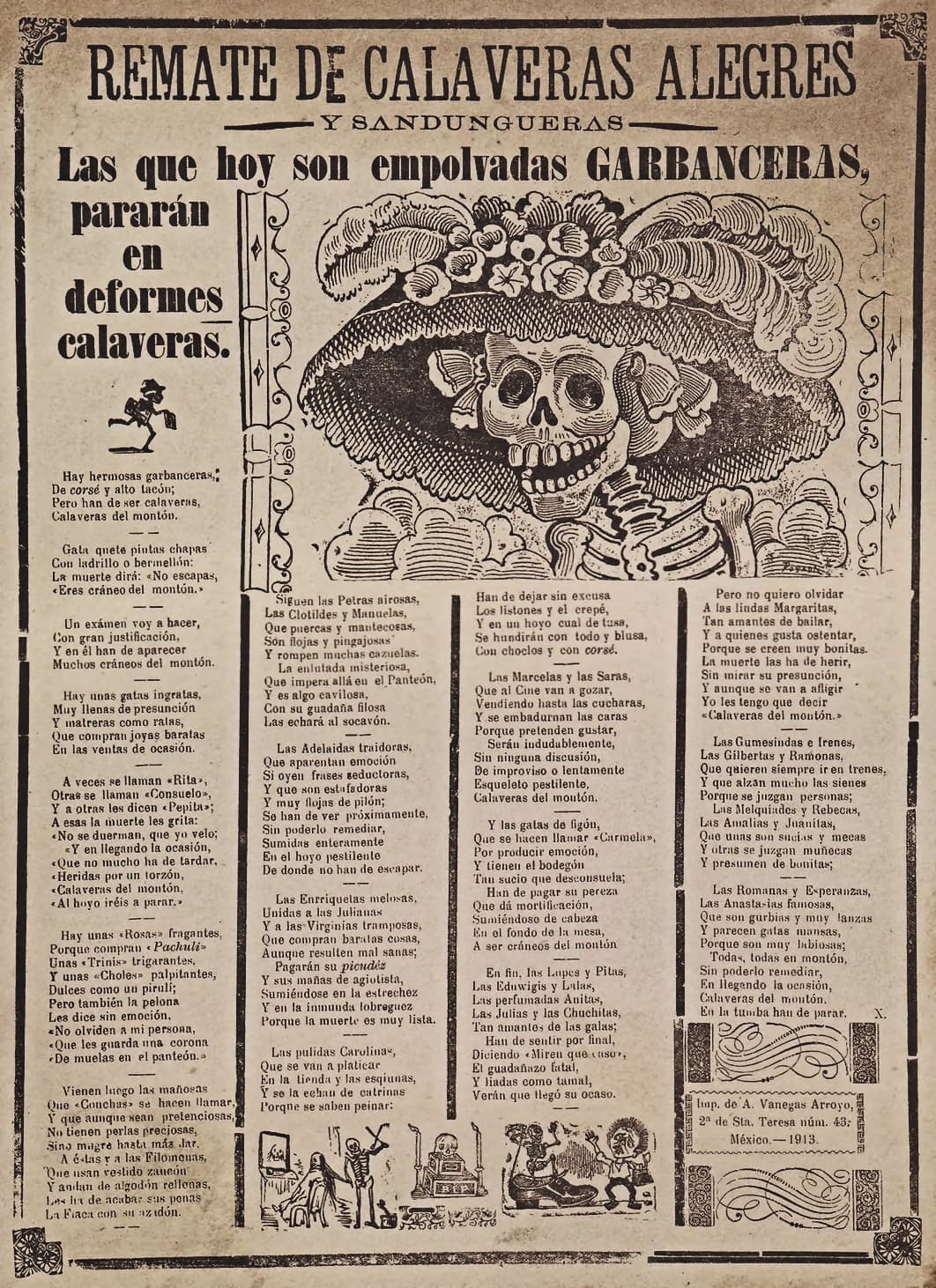 La Calavera Garbancera by José Guadalupe Posada, on a 1913 broadsheet (public domain) |
| She owes the name we know today to Diego Rivera. In his mural Sueño de una tarde dominical en la Alameda Central (Dream of a Sunday Afternoon in the Alameda Central, 1946–1947), he painted her full-length, with a feather boa, arm in arm with Posada and holding hands with a young Diego, with Frida Kahlo behind them. And he christened her Catrina: in Mexico, a catrín is an elegant, rather vain man who is always very well dressed. You can see the mural at the Museo Mural Diego Rivera in Mexico City. | 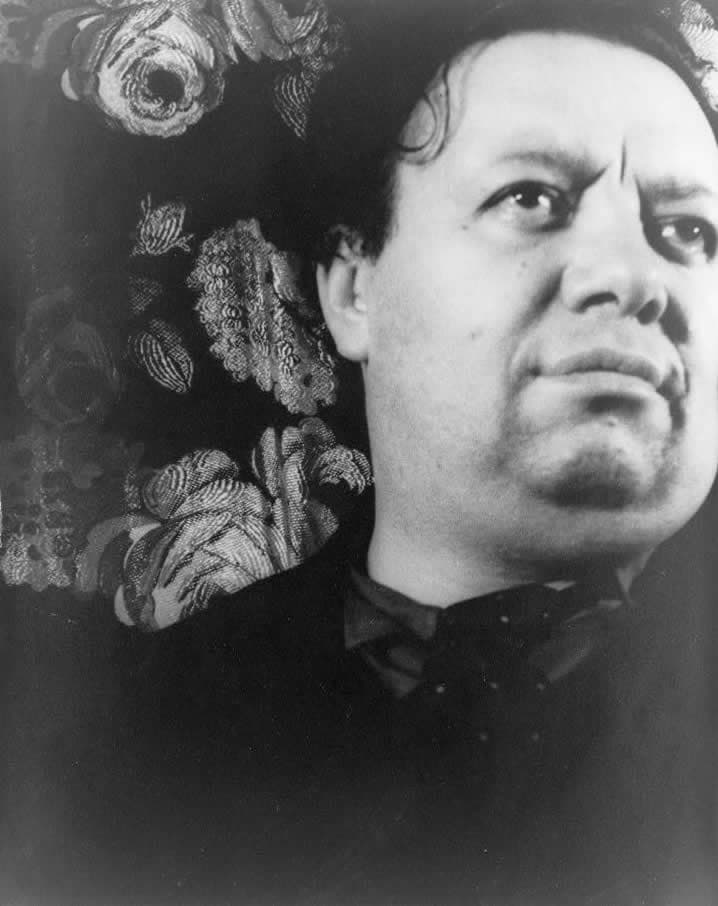 Diego Rivera in 1932. Photo: Carl Van Vechten, Library of Congress (public domain) |
The Word That Didn’t Make It into the Video: Cempasúchil
| In the video we talk about flores de Día de Muertos, but in Mexico almost everyone calls them cempasúchil. The word comes from the Nahuatl cempōhualxōchitl, usually translated as “twenty flowers” or “twenty-petalled flower”: cempōhualli means “twenty” and xōchitl “flower”. Its scientific name is Tagetes erecta, and in English it’s known as Mexican marigold or Aztec marigold.
Watch the pronunciation: the stress falls on “sú”, cem-pa-SÚ-chil. And don’t be surprised to see it spelled other ways, such as cempasúchitl, closer to the original Nahuatl. Why didn’t we use it in the video? Because it’s a very local word and, in our dialogue, a bit of a trap: Elena says ahorita te las llevo (I’ll bring them to you in a minute; las = the flowers), and with the singular el cempasúchil, the sentence confused more than one student. |
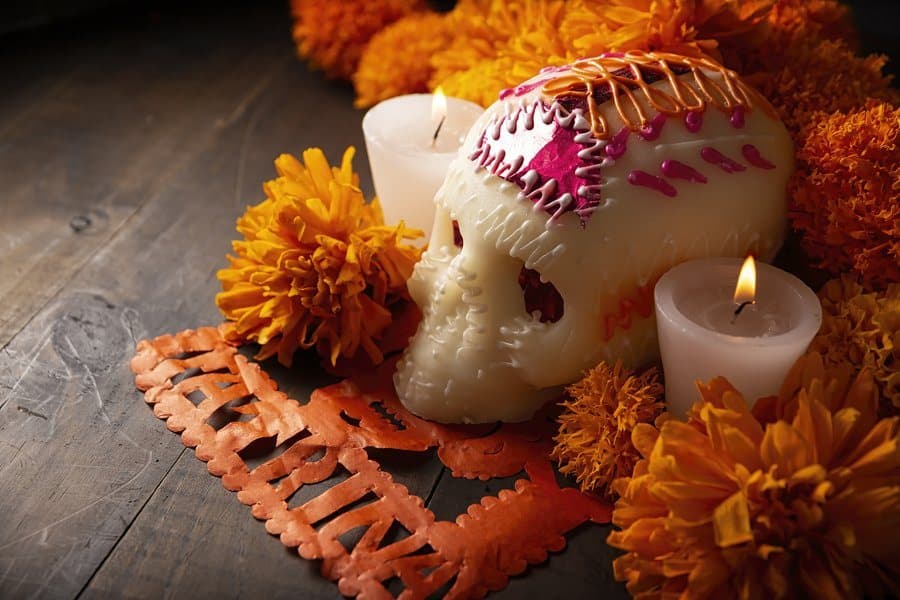 Cempasúchil, candles and papel picado around a sugar skull |
What Goes on an Ofrenda (and Why)
| Besides photos, the person’s favourite food and the flowers, an ofrenda almost always includes these items, each with its own meaning:
• water (el agua), to quench the souls’ thirst after their long journey; • salt (la sal), which purifies; • candles (las velas), whose light guides the souls back to their old home; • copal (el copal), a resin of pre-Hispanic origin, burned like incense to cleanse the space; • papel picado, colourful tissue paper cut into patterns, which represents air. |
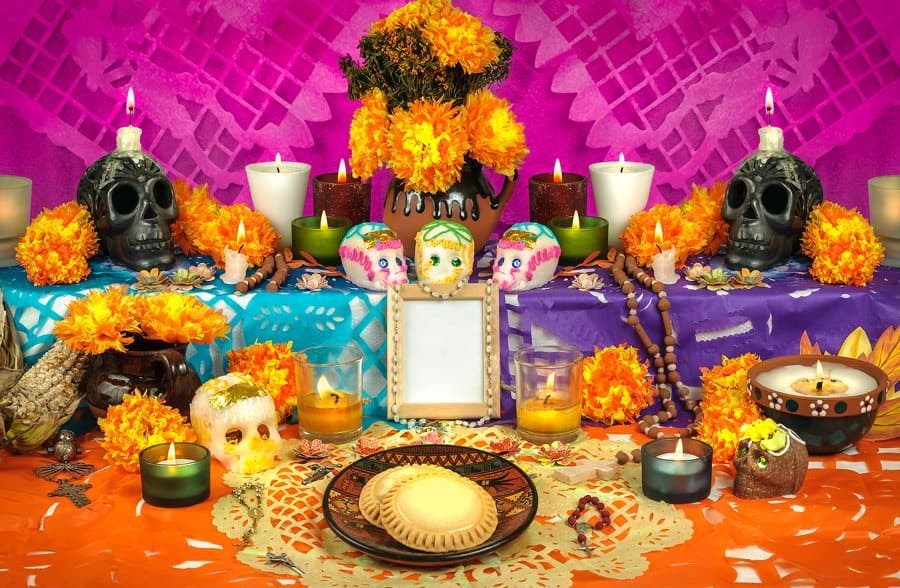 An ofrenda with cempasúchil, candles, skulls and papel picado |
Calaveritas Literarias
| Skulls aren’t just for eating: they’re for writing, too. Calaveritas literarias are short rhyming poems that imagine a living person —a politician, a celebrity, a colleague…— already dead, as an excuse to poke fun at them, affectionately… or not. The earliest known examples were published in 1879 in El Socialista, a newspaper in Guadalajara, and they were often censored for their criticism. Today children write them at school, and newspapers publish their own every November.
Here’s one we wrote for our dear Don Fíjate: |
 |
La Catrina, muy coqueta,
fue a buscar a Don Fíjate:
—Vámonos, que ya es la hora
y no hay tiempo para debates.
—Espere, señora Muerte
—le contestó, muy cortés—,
que antes tengo que explicar
el subjuntivo y su porqué.
—Me voy sola —dijo al rato—,
que esto no hay quien lo aguante.
Pero el año que viene vuelvo,
¡cueste lo que cueste, Fíjate!
In English, more or less: La Catrina, all dressed up, comes to fetch Don Fíjate because his time is up. “Just a moment, Madam Death,” he replies politely, “first I have to explain the subjunctive and why we use it.” After a while she gives up: “I’m off on my own, this is unbearable! But I’ll be back next year, cueste lo que cueste (whatever it takes).”
A Parade Invented by James Bond
| Did you know that Mexico City’s big Day of the Dead parade exists thanks to James Bond? At the beginning of Spectre (2015), 007 chases a villain through a spectacular parade of skeletons in the centre of the capital. That parade didn’t exist: the film made it up.
But after the film came out, lots of tourists turned up asking about it, so the city decided to make it real. The first one was held on 29 October 2016, along Paseo de la Reforma to the Zócalo, and it has been held every year since. A curious case of tradition imitating fiction. |
 The Day of the Dead parade in Mexico City |
Don Juan Tenorio: A Surprise Ending
| In the video we tell you that Don Juan Tenorio is staged every November. José Zorrilla premiered it in 1844, and his Don Juan has something that sets him apart from other Don Juans in literature, such as Tirso de Molina’s, who ends up in hell: Zorrilla’s is saved at the end, thanks to doña Inés’s love.
That’s why it suits the season so well: it’s a play about death, but also about love and forgiveness. And many theatregoers love to murmur along to its most famous lines: ¿No es verdad, ángel de amor, / que en esta apartada orilla / más pura la luna brilla / y se respira mejor? (Isn’t it true, angel of love, that on this secluded shore the moon shines more brightly and the air is easier to breathe?) |
 Don Juan in the cemetery, among statues and candles |
In Spain: Fritters and Wandering Souls
| In Madrid and many other parts of Spain, the sweet of the season is buñuelos de viento: little balls of fried dough, rolled in sugar and sometimes filled with custard or chocolate. According to popular tradition, every buñuelo you eat frees a soul from purgatory. The perfect excuse for a second helping! | 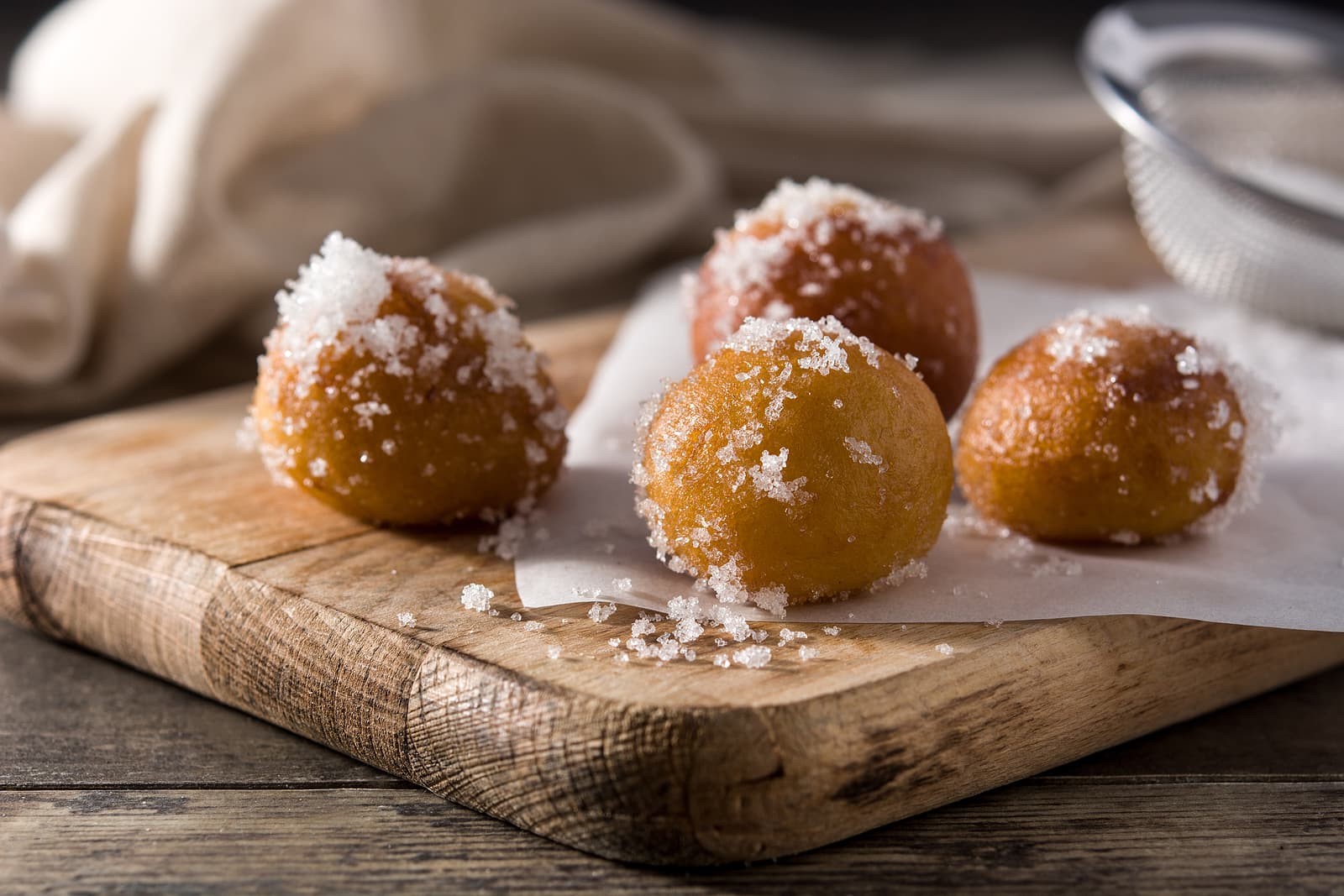 Buñuelos de viento |
| And if you like ghost stories, in Galicia they tell the legend of the Santa Compaña: a procession of souls in torment that walks the paths and woods at night, in two lines, in robes and carrying candles. It’s led by a living person carrying a cross and a cauldron of holy water, who can only escape the curse by passing the cross to someone else. So if you’re walking through a Galician forest at night and someone offers you a cross… better not take it! |  A Santa Compaña by Camilo Díaz Baliño (1919, public domain) |
And in Latin America…
| In Guatemala, in Sumpango and Santiago Sacatepéquez, people fly barriletes gigantes on 1 November (that’s what kites are called there): huge circles of bamboo and coloured paper, several metres across, made in memory of the dead. In 2024, UNESCO added the technique for making these kites to its list of the Intangible Cultural Heritage of Humanity. And on that day, Guatemalan families eat fiambre: a huge cold salad with dozens of ingredients (cold meats, sausages, vegetables, cheeses…), which every family makes its own way. And you already know what else un fiambre is in Spain… Very fitting for the season!
In Ecuador, 2 November isn’t complete without colada morada, a thick, hot drink made with purple corn, fruits such as blackberries and mortiño, and spices, served with guaguas de pan, little breads shaped like babies. Guagua means “child” or “baby” in Quichua… but careful: in Cuba, Puerto Rico or the Canary Islands, a guagua is a bus. And in La Paz, Bolivia, 8 November is the Fiesta de las Ñatitas: people take the human skulls they keep at home —of relatives or strangers— to the Cementerio General, decorated with flowers, hats and even sunglasses, to thank them for their protection during the year. Ñatita comes from ñato, which in Latin America means “snub-nosed”: exactly what happens to a skull. |
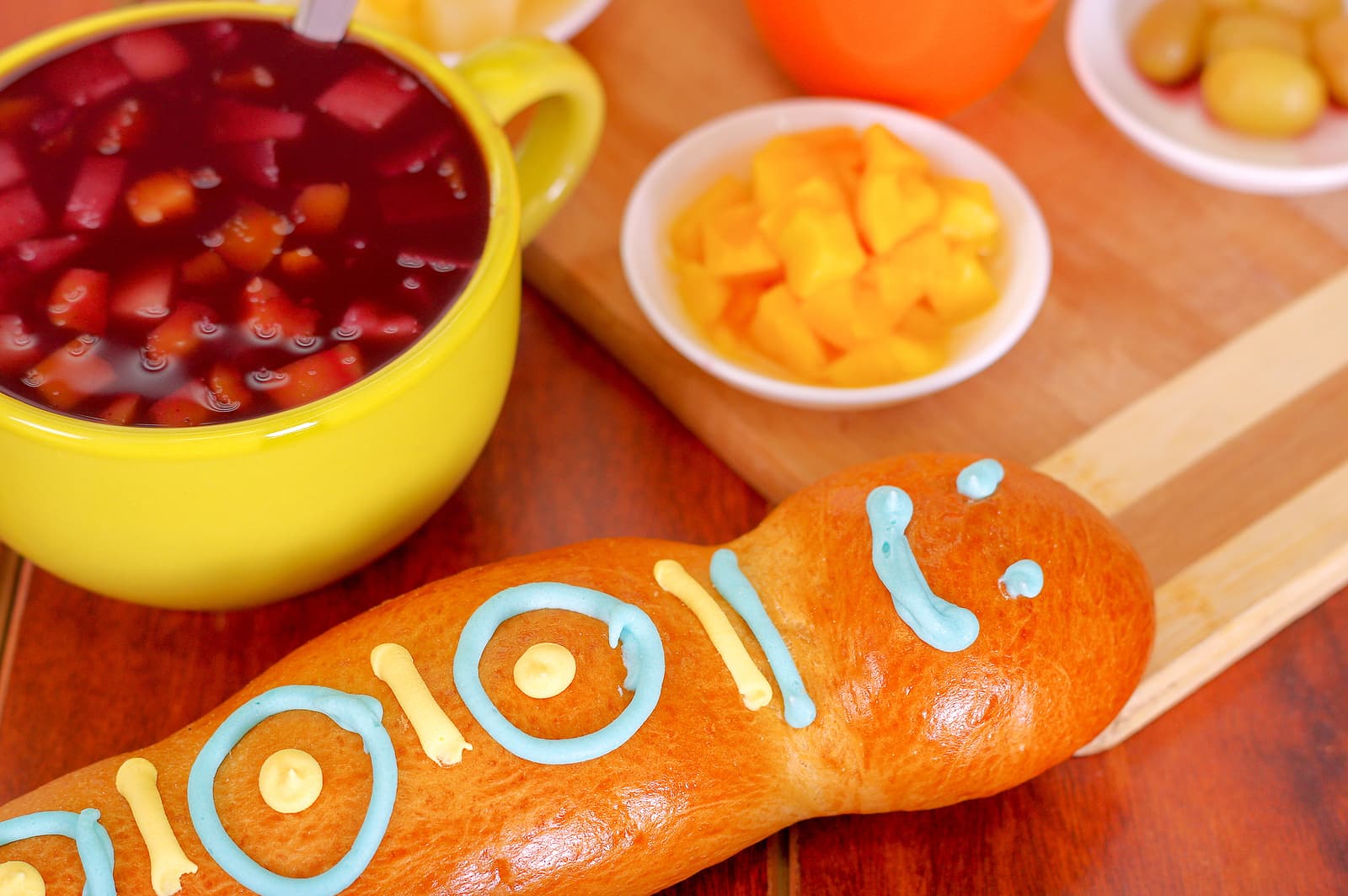 Colada morada and guaguas de pan, in Ecuador |
These are just a few examples: every corner of the Spanish-speaking world remembers its dead in its own way.
If you’d like to keep exploring (in Spanish): the history of the Day of the Dead, the giant kites of Sumpango, the origin of colada morada and guaguas de pan, the cult of the ñatitas in Bolivia and, if you dare, the legend of the Santa Compaña, told in drawings.
Frequently Asked Questions About All Saints’ Day and the Day of the Dead
Here are answers to the most common questions, with references to official sources and reputable media.
What is celebrated on 1 November in Spain?
All Saints’ Day (el Día de Todos los Santos), a festival of Christian origin that is a public holiday throughout Spain. Many families visit the cemetery to clean and decorate the graves with flowers, usually chrysanthemums, and it’s traditional to eat huesos de santo, buñuelos de viento, panellets or roasted chestnuts, depending on the region.
What’s the difference between All Saints’ Day and All Souls’ Day?
All Saints’ Day (1 November) honours all the saints, known and unknown. All Souls’ Day, el Día de los Fieles Difuntos (2 November), remembers everyone who has died. Because the 1st is a public holiday in Spain, cemetery visits usually happen that day, which is why the two are often confused, as the Spanish newspaper El Debate explains (in Spanish).
What is the Day of the Dead?
El Día de Muertos is Mexico’s great festival for the dead, celebrated on 1 and 2 November. It blends pre-Hispanic Indigenous beliefs with Catholicism: families build ofrendas to welcome the souls of their loved ones, who, according to tradition, come home on those days. In 2008 UNESCO inscribed it on its Representative List of the Intangible Cultural Heritage of Humanity, as its official page records.
Why does the Day of the Dead last two days?
Traditionally, 1 November is dedicated to children who have died, affectionately called angelitos (little angels), and 2 November to adults. That’s why many ofrendas include toys and sweets for the little ones.
Is it “Día de Muertos” or “Día de los Muertos”?
In Mexico it’s Día de Muertos, without the article. You’ll also hear Día de los Muertos, especially in the United States, but the Mexican form is Día de Muertos.
Is the Day of the Dead the Mexican Halloween?
No. They fall on similar dates and both have skulls, but they have nothing to do with each other. Halloween is about costumes and scares; the Day of the Dead is a family celebration to remember and welcome loved ones who have died, with ofrendas, flowers and food.
Who created La Catrina?
The Mexican engraver José Guadalupe Posada, who drew her in the early 20th century as la Calavera Garbancera, a satire of people who rejected their roots. Diego Rivera painted her full-length in his mural Sueño de una tarde dominical en la Alameda Central (1946–1947) and popularised her as “Catrina”, as the Mexico City magazine Chilango explains (in Spanish).
What is cempasúchil?
It’s the orange marigold (Tagetes erecta) that decorates ofrendas and graves on the Day of the Dead. Its name comes from the Nahuatl cempōhualxōchitl, “twenty flowers”, as National Geographic en Español notes (in Spanish). According to tradition, its colour and scent guide souls back home.
How do you say “All Saints’ Day” in Spanish?
El Día de Todos los Santos, or simply Todos los Santos. All Souls’ Day is el Día de los Fieles Difuntos or el Día de Difuntos, and the Day of the Dead is el Día de Muertos.
Any more questions? Leave us a comment below.
Keep Exploring with Us
Explore Hispanic culture with us! And if you celebrate 1 November too —with chestnuts, an ofrenda or a Halloween pumpkin— tell me about it in the comments: I love hearing about your cultural adventures with Spanish.
The second lesson, ¡Por encima de mi cadáver!, is coming soon: how to talk about death in Spanish, with formal and informal expressions, and even a few funny ones.
We have more Seasonal Spanish video lessons, each with its own annotated transcript, grammar notes and activities. The easiest way to get all the material —the student PDF and the teachers’ notes for group and one-to-one classes— is through our Free Resources; once you’ve registered, you’ll have direct access to the PDFs for the whole series, not just this lesson. You can also watch the rest of the series on our YouTube playlist.
At Real Spanish you’ll find other free resources too: videos, transcripts, vocabulary lists, and practice activities and tests. Hope to see you there!
Ready for something more challenging? Try a couple of free lessons from our online Spanish courses.
Best wishes from Barcelona,
Elizabeth, from Real Spanish