
Trocitos de Real Spanish

«¡Me han echado!» and other expressions with «echar»

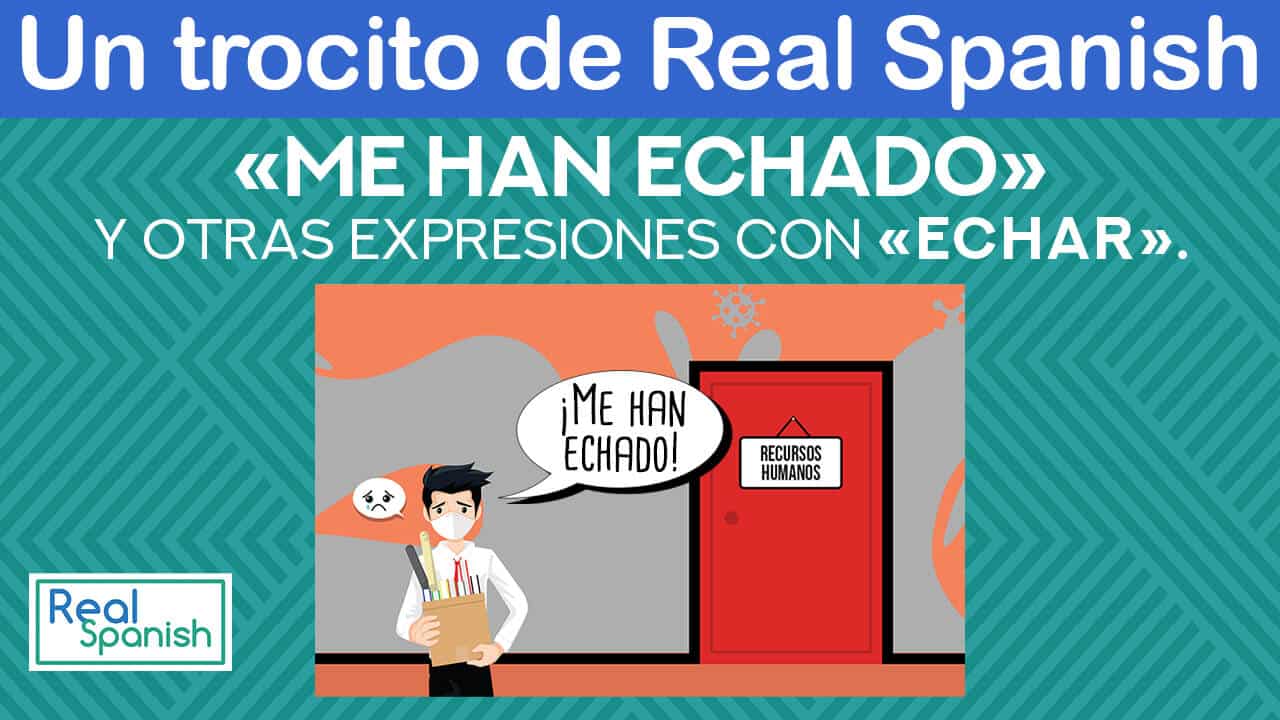
This is the transcription of the video above. In this video we explain various Spanish expressions with the verb «echar». We recommend that you view the video several times, with and without the transcription, until you understand and can distinguish every word. It’s also useful to read aloud, chiming in with the instructor. In this way you can improve your pronunciation and intonation. If you'd like to just listen to the audio, you can find it on Soundcloud. English transcription of the video: Hi! I’m Inés Alba, from Real Spanish. I’m sure you already know the expression echar de menos. This expression is used mostly in Spain because in Latin America they usually say extrañar. The verb echar has different meanings in Spanish. It can mean throwing something, putting on adding or applying some product, or adding (salt etc.). It can also be used with the meaning of firing someone from work. This verb can be used with the preposition a and an infinitive to express the abrupt start of an action. For example: echar a correr (to set off at a run) or echarse a llorar (to burst into tears). There are also many colloquial expressions with the verb echar. For example, do you know the expression «echar algo en cara»? It means to reproach or accuse someone (to throw it in someone’s face). That is, if someone has misbehaved with you, you can address this person to express your complaint about their behavior. Another widely used expression is echarse atrás which means to back out of an agreement, a deal or a promise. To speak Spanish fluently, it’s good to learn expressions like these. In Real Spanish you will find many mini-lessons based on common words with many uses such as salir, leche, huevo, marchar, vuelta.... Visit our website now and try our free sample lessons. You’ll love them! See you soon! Do you know any other expressions with «echar»? Please leave us a comment, a question or a suggestion: we'd love to hear from you! Do you know that you can now book private online lessons with Gema, our star teacher?   Real Spanish: Online Spanish courses and mini-lessons for people who are serious about improving their Spanish Click here to view all our materials and book your free sample lesson with  Gema.
Un trocito de Real Spanish: ¡No damos abasto!

This is the transcription of the video above. Antonio brings you up to date on what we've been doing lately on Real Spanish. If you like, you can start by reading the English transcription. To get the most out of the video, we recommend that you view it several times, first with and then without the transcription, to improve your listening comprehension.  It's also a good idea to read aloud, chiming in with Antonio, to improve your pronunciation and intonation. ¡Hola! Soy Antonio, profesor de Real Spanish. Te voy a poner al tanto de nuestras mini-lecciones. Ya tenemos tantas que casi no damos abasto. Hemos tenido que organizarlas en categorías, o series. El contenido de nuestras mini-lecciones es muy variado. Entonces estas son las distintas series. Temas de historia y cultura: por ejemplo, «¡Es una chapuza!», que trata del patrimonio artístico de España. Esta es una muestra gratuita: si no la has visto aún, ¿a qué esperas? Expresiones que expresan una función o propósito o se relacionan con un solo tema: por ejemplo, «¡Qué va!» y otras expresiones para rechazar una idea, una sugerencia o una solicitud . Expresiones con palabras comunes: por ejemplo «¡Salir rana!» y otras expresiones con la palabra «salir». Expresiones relacionadas con el cuerpo humano: por ejemplo, «Por los pelos». Minis basadas en clips de TV, cine y podcasts: por ejemplo, «¡Panda de vagos!», basada en la película Ocho apellidos vascos. Hoy destaco la serie sobre temas de historia y cultura. Hasta ahora hemos publicado las siguientes mini-lecciones: «Es una chapuza»: obras de arte mal restauradas «¿De dónde viene la lengua vasca?» «Echar una siesta» y otras expresiones relacionadas con el largo día laboral de España «Estar en el quinto pino» y otras palabras y expresiones para hablar del campo «No hay moros en la costa» y otras curiosidades de la historia de Cataluña «¡Tengo que encontrarla!»: el escándalo de los niños robados «¡Ni qué gaitas!»: Hechos clave y curiosidades de Galicia Si te encanta aprender cosas interesantes sobre el mundo hispánico mientras mejoras tu español, estas mini-lecciones son para ti. Haz clic abajo para saber más. ¡Hasta luego! Hi! I’m Antonio, a teacher at Real Spanish. I’m going to bring you up to date on our mini-lessons. We now have so many that we can hardly keep up and we’ve had to organize them in categories, or series. The content of the mini-lessons is very varied, as you can see below: History and culture: for example, «¡Es una chapuza!», about Spain’s artistic heritage. This is a free sample lesson; if you haven’t seen it yet, what are you waiting for? Phrases that express a particular purpose or are related to a specific context: for example, «¡Qué va!» and other expressions you can use to reject an idea, a suggestion, or a request. Common words that are used in many different ways: for example, «¡Salir rana!» and other expressions with «salir». Expressions related to parts of the human body: for example, «Por los pelos». Mini-lessons based on

Un trocito de Real Spanish. «¡Es muy chulo!» y otras expresiones para dar el visto bueno

This is the English transcription of the video above. Have you heard the expression «!Qué chulo!»? It's very colloquial and means  "fantastic" or "great". In this video you'll learn a few more expressions for the same idea.Hi! I’m Inés Alba, from Real Spanish. Do you know the courses offered by the Real Spanish website? They are una pasada. This means that something is amazing or really good, and is used when someone likes something very much. In Spanish there are many ways to give the go-ahead or express that you like something very much. Perhaps you have already heard the expression ¡Qué guay! which is one of the most used. But there are others like the adjective chulo or chula with the meaning of pretty but at the same time something modern, original, different. For example, I can say ¡Qué vestido más chulo! or ¡Qué casa más chula! or simply: ¡Qué chulo/a! But be careful with this word because if you say that a person is un chulo or una chula, it has a different meaning. It means that he/she is an arrogant person. And un chulo can also mean someone who controls and exploits prostitutes. Another way to express that you like something is by using the verb molar. We can say that algo mola mucho or me mola algo; in this case it works like the verb gustar.  A widely-used expression is ¡Cómo mola! to indicate that something or someone is nice, fun, cheerful… Well, I hope you can use some of these expressions soon. You will sound like a true native! On our website you can find many mini-lessons based on colloquial expressions that are really cool. Visit us now! See you soon! Do you know any other expressions with similar meanings? Please leave us a comment, a question or a suggestion: we'd love to hear from you! Do you know that you can now book private online lessons with Gema, our star teacher?   Real Spanish: Online Spanish courses and mini-lessons for people who are serious about improving their Spanish Click here to view all our materials and book your free sample lesson with  Gema.
Novedades de Real Spanish: Clases particulares

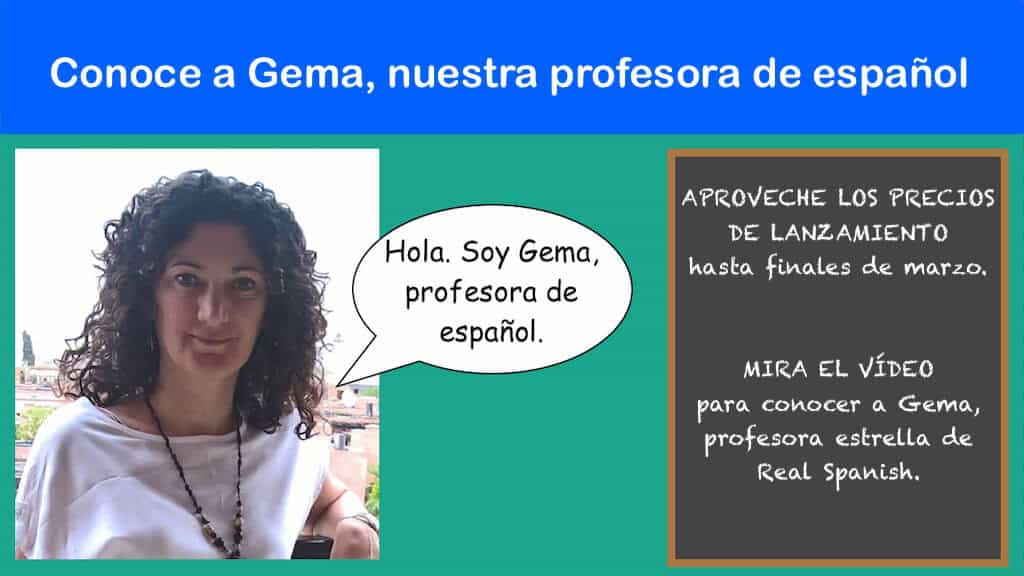
This is the transcription of the video above, in which Carmen tells you about our new private online Spanish lessons, and introduces you to Gema, our star Spanish teacher. Her lessons will help you to to deepen and reinforce what you learn in our online Spanish video-lessons. You can book a free trial lesson with Gema right now. Click below for more information: Gema is waiting for you!Do you know that we now offer private online Spanish classes? These classes will help you get the most out of our courses and mini-lessons. Our teacher will ask you questions to make sure you have understood, and to help you practise the important vocabulary. Profesora: Bueno, entonces, ¿sabes qué diferencia hay entre una caja y una caja de ahorros? Estudiante: Creo que una caja de ahorros es como un banco, ¿no?   You can express your personal opinion, say whether you agree or disagree on a particular topic, or simply improve your oral expression as you talk about something in the lesson. Profesora: ¿Entonces qué opinas de la actitud de Xoán con su padre? Estudiante: Me parece que es muy duro con él, ¿no? Profesora: Claro, pero tenemos que tener en cuenta que no es fácil cuidar a una persona enferma, ¿verdad? ¿Alguna vez has tenido que cuidar de alguien?   The teacher corrects the student from time to time, but not too much, because the important thing is that you feel comfortable speaking Spanish. Profesora: ¿Sabes por qué está tan enfadado Xoán con su padre? Estudiante: Porque es muy mayor y empeza a perder su memoria. Profesora: Sí, empieza a perder la memoria. Recuerda que el verbo empezar es irregular, entonces decimos él... Estudiante: ... empieza. Profesora: Perfecto, muy bien. Y, ¿cómo lo sabes?   You can also ask questions about points of grammar that you don’t understand, and practise with an extra activity if necessary. Estudiante: Hay algo que no entiendo, ¿por qué se usa el subjuntivo en la frase «no hay quien lo aguante»? Profesora: ¡Ah! Buena pregunta. ¿Has estudiado alguna vez las oraciones de relativo? Estudiante: Pues la verdad es que no me acuerdo… Profesora: Pues mira, te explico…   But you don’t have to limit yourself to the content of the lesson. Our teacher will help you in any way you need. OK, may I present Gema, our teacher. If you want to see this video in English, advance the video one minute. _____________ Hi! I’m Gema. I’m a native Spanish teacher with more than 15 years of experience and I have a Master’s Degree in Teaching Spanish for Foreigners. My methodology is communicative. I think the best way to learn is by speaking and interacting. But you can practise all the language skills you need: writing, or listening… because my lessons are tailored to each student. In our free sample lesson, we are going to talk a little bit to get to know your level and to create a study plan according to your goals, needs

«En absoluto» o «absolutamente»?

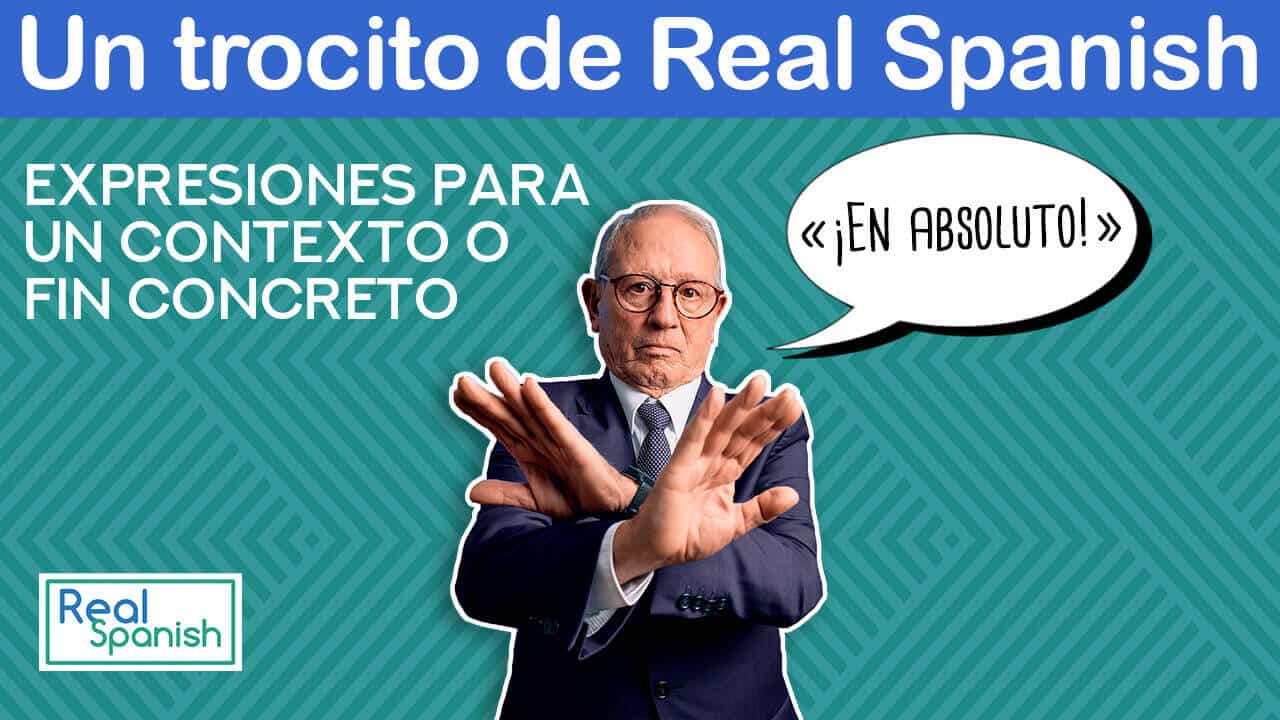
This is the transcription of the video above. You can choose to view the video before or after reading the text. We suggest you also listen to the audio while reading the text, chiming in with Celia from time to time to improve your pronunciation and intonation. Transcription: Hello! I'm Celia, a teacher from Real Spanish. Do you know the difference between "en absoluto" and "absolutamente"? With "absolutamente" we express agreement but with "en absoluto" we express complete rejection. In the mini-lesson "¡Qué va!" we explain other expressions to reject an offer, request, suggestion or idea. It is one of several lessons on expressions that can be used for specific purposes or contexts. In addition to "¡Qué va!" we already have the video "Salir de dudas", which is about the various ways of expressing doubt or probability, using the subjunctive or the indicative. The mini-lesson "A toda caña" deals with expressions to talk about speed. Do you feel nervous when you have to speak on the phone in Spanish? In "¡Dígame!"  we explain several phrases that are widely used in formal and informal calls. And in "Quien la sigue la consigue" we give you linguistic and cultural guidelines to look for a job in Spanish. Right now we are working on "¡A mí no me torea nadie!" a mini-lesson that focuses on the context of the bullfighting world. If you haven't tried any of our mini-lessons yet, you can try "Es una chapuza" for free, which is about a restoration project that shocked everyone. It's one of our series of mini-lessons based on news clips and documentaries. What are you waiting for? Click below to try it out right now. If you have encountered other expressions like these, tell us below. We'd love to hear from you: please leave a comment, a question or a suggestion below. Real Spanish: online Spanish courses and mini-lessons for people who are serious about improving their Spanish.     Ver todos nuestros materiales y probar algunas lecciones de muestra

Un trocito de español: ¿Conoces la expresión «Salir de rositas?

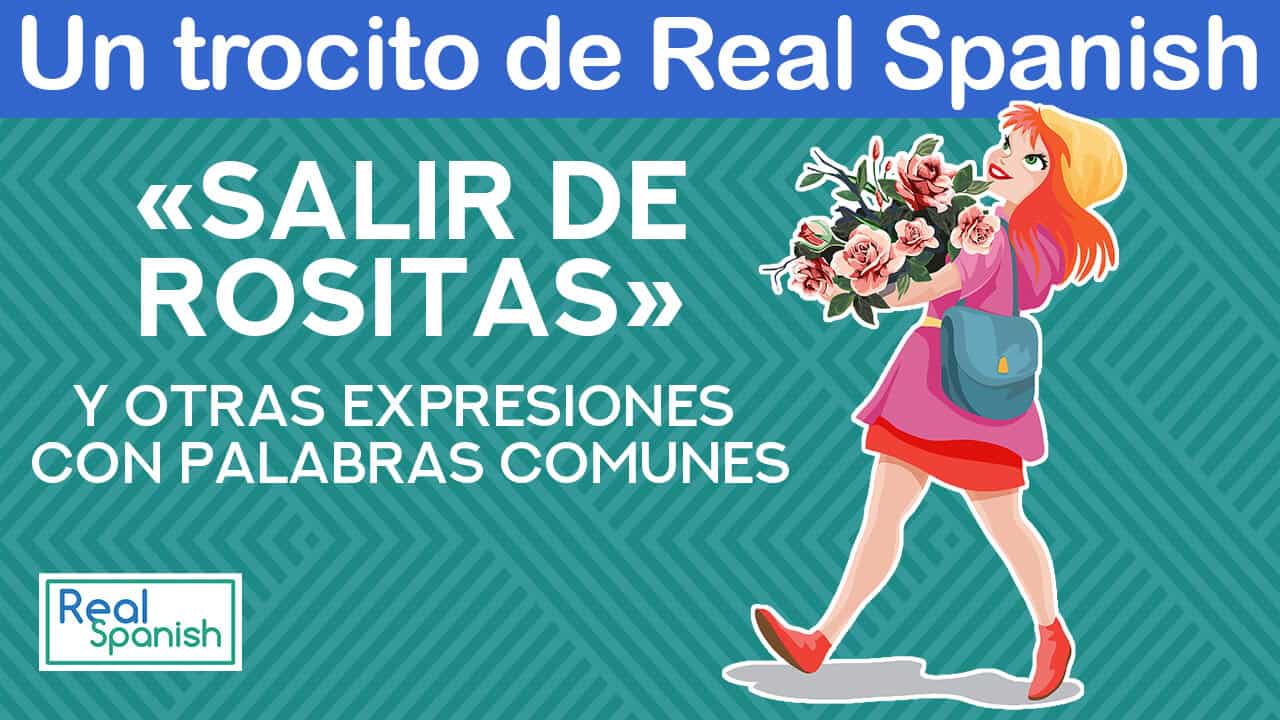
In the video above, Antonio explains some uses of the verb «salir». You can choose to view the video before or after reading the text. The English transcription is below. We suggest you also listen to the audio while reading the text, chiming in with Antonio from time to time to improve your pronunciation and intonation.  English Transcription: Hi! I’m Antonio, a teacher with Real Spanish. Do you know the expression «salir de rositas»?  It means someone has done something to earn a punishment or a scolding, such as a child’s prank, but doesn’t receive blame or punishment. Another expression with «salir» is «salirse con la suya». For example, listen to this conversation between Antonio and Celia, leaving a restaurant. Antonio: I don’t want to go out for dinner with that couple ever again. She’s a real pain, always wants to argue about something. Celia: Well, you’re right, tonight she just wouldn’t stop complaining. Antonio: First she doesn’t eat pizza because she doesn’t eat bread, next she doesn’t like Mexican food, then the bar on the corner is really tacky… Celia: The rest of us wanted to go to Pedro’s bar but in the end she got her own way, as usual. «Salir» has many other uses. You can learn some of them with our mini-lesson «Salir rana». We also have other mini-lessons that explain the different uses of common words. If you haven't tried any of our mini-lessons yet, you can try «Es una chapuza», a free sample lesson about an art restoration project that scandalized everyone. It’s one of our series of mini-lessons based on clips from news programs and documentaries. What are you waiting for? Click below to try it right now. Click here to view all our materials and try some free lessons. Check out this blog entry for more wyas to use the Spanish verb «salir». If you’ve encountered other expressions with «salir», tell us about it below, in English or in Spanish. Real Spanish: online Spanish courses and mini-lessons for people who are serious about improving their Spanish. If you have other comments, questions or suggestions, we’d love to hear from you!   View all our materials and try some free sample lessons.

This site is registered on wpml.org as a development site. Switch to a production site key to remove this banner.