

Trocitos de Real Spanish

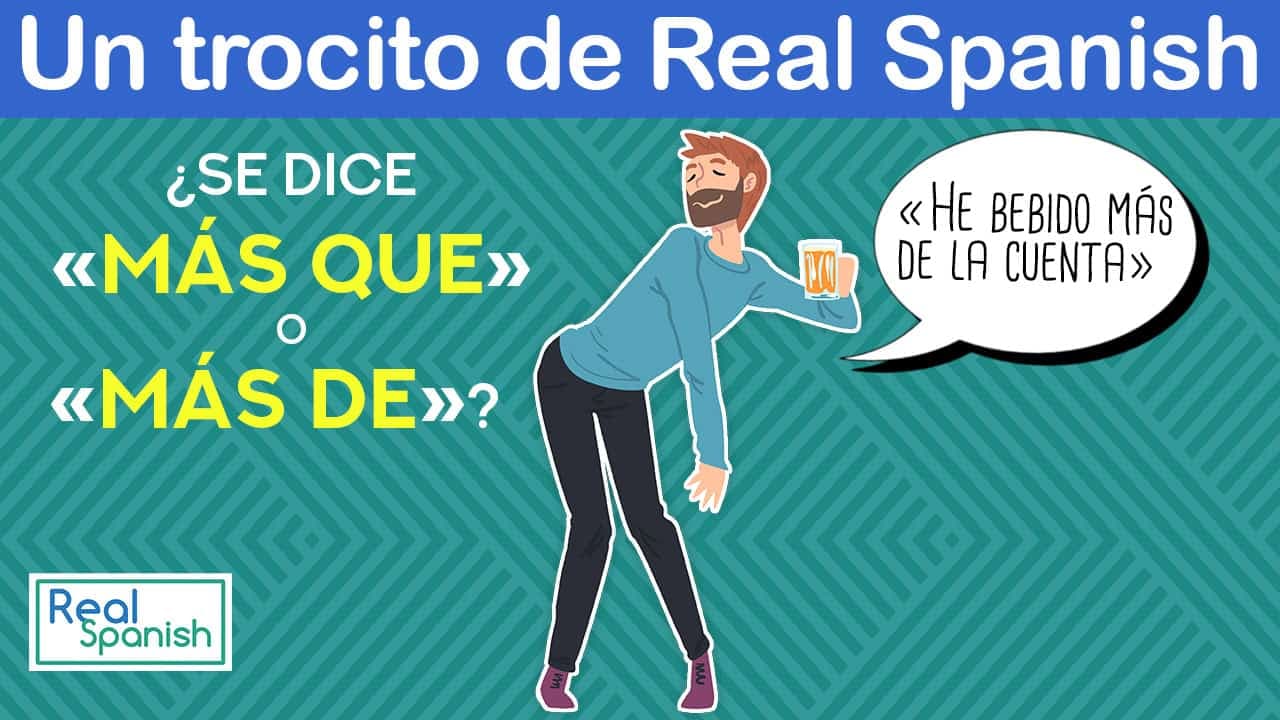
«Has bebido más de la cuenta»: how to use «más que» and «más de»

¿Do you still have problems with  «más de» and «más que»? José explains! (transcription below). Hello and welcome to Real Spanish! Are you still not sure when to use «más que» or «más de»? It's natural, they sound similar but their meanings are different. We use «más que» in comparisons of people, things, places animals, objects, and even actions. Look at these examples: Susana trabaja más que Pedro. Susanna works more than Pedro. Me gusta cantar más que bailar. I like singing more than dancing. Llevo más tiempo en este negocio que tú. I've been in this business longer than you. Me fío de Patricia menos que de su hermana. I trust Patricia less than her sister.   «Más que» is also used to express superiority or inferiority with an adjective or adverb, according to this structure: «más/meno + adjective/adverb + que». For example: Mi hermano es más alto que yo. My brother is taller than me. La tortuga se mueve más lento que la liebre. The tortoise goes more slowly than the hare. Ella habla menos que su hermana. She talks less than her sister.   Another use of «más que» is to express the existence of only one possibility, or of an exception. These examples will help to make this clearer: Nadie más que el guardia de seguridad puede quedarse en la oficina por la noche. Nobody except/other than the security guard can stay in the office at night. No haces más que criticar a tu jefe. You do nothing but criticize your boss. As for «más de» and «menos de», we use these phrases with numbers and quantities. For example: Tengo más de diez pares de zapatos negros. I have more than 10 pairs of black shoes. Has llegado más de cuantro horas tarde. You're more than four hours late Más de la mitad de los alumnos llegan al colegio sin haber desayunado. More than half of the students arrive at school without having had breakfast. Menos del 50% de los votantes han votado. Fewer than 50% of the eligible votes have voted. Esta película no es apta para niños de menos de 13 años. This movie is not suitable for children under 13 years of age.   We also use «más de» and «menos de» with relative clauses introduced by «lo que»:  For example:  Como más de lo que te imaginas. I eat more than you think. Tengo menos edad que lo que crees. I am younger than you think.   And before I go, do you know the expression «más de la cuenta»? It means too much, or more than you should. For example Has bebido más de la cuenta, ahora estás muy borracho. You've had too much to drink, you are really drunk. Peso más de la cuenta, tengo que adelgazar. I weigh too much, I have to lose weight. Bye for now! Please leave us a comment, a question, or a suggestion below: we’d love to hear from you! Follow us on YouTube


Me importa un huevo

  This is a preview of our mini-lesson about colloquial Spanish expressions with the word «huevo». Some expressions with «huevos» are quite vulgar, because the word can also refer to "testicles" or "balls". If you only want to listen to the audio, you can find it on Soundcloud.  Hi! Today I’ll explain some colloquial uses of the word «huevo». Some of these expressions are quite vulgar, because in colloquial language «huevos» can mean “testicles” or “balls”, so be careful how you use them! Have you heard the expression «Me importa un huevo»? It means “I don’t care” or “I don’t give a shit.” In Mexico «a huevo has two meanings, depending on the context. It can be a strong yes, or the equivalent of “You bet!” For example, «¿De verdad vas a aceptar ese trabajo? Tendrás que viajar mucho». (Are you really going to accept that job? You’ll have to travel a lot.) «A huevo, no puedo perderme tal oportunidad.» (You bet I am, I’m not going to miss such an opportunity.) It can also mean «pase lo que pase» (no matter what). For example, «Tengo que terminar este proyecto para el viernes, a huevo» (I have« to finish this project by Friday, no matter what (or, come hell or high water). In Spain, «a huevo» means «a tiro» or «alcance» (it’s easy, a piece of cake, a walk in the park). For example, «Te has preparado muy bien la entrevista y ya conoces al jefe, vas a conseguir el trabajo seguro, lo tienes a huevo» (You are well prepared for the interview and you already know the boss, so it’s a piece of cake for you). There are so many expressions with «huevo» that we have created a mini-lesson on the topic. It consists of: A video An annotated transcription A set of grammar notes A couple of interactive exercises Click below to learn more. OK, that’s all for today. Bye for now!   If you liked this video, you will enjoy our complete mini-lesson on the topic. . You can get five minis for the price of four! Click here to learn more.  Follow us on YouTube  soyou don't miss any of our Trocitos de Real Spanish!   Get in touch. We'd love to hear from you. You can leave us a comment, a question or a suggestion. You can also participate on our You Tube Community Page. You'll find quizzes, surveyas and interesting points of vocaulary and grammar.   Improve your Spanish with us. Click here to learn more about all our materials. Real Spanish: Courses and mini-lessons online for people who are serious about improving their Spanish.  

«¡Se acabo!» and other uses of «acabar»

The video above explains some uses of the verb «acabar». The English transcription is below. If you just want to listen to the audio, you can find it on Soundcloud.  Hello and welcome to Real Spanish! Today we bring you some uses of the verb «acabar». I'm sure you already know that this verb means "to finish" or "to end" something. However, «acabar de» + infinitive is used to indicate that something has just happened. For example: - Acabo de lavarme el pelo. - I've just washed my hair. Be careful with the negative though, because «no acabar de» + infinitive means to be unable to do something, no matter how hard you try. Look at this example: - No acabo de entender la diferencia entre «ser» y «estar». -I can’t figure out the difference between «ser» and «estar». On the other hand, «acabar por» + infinitive means to do something after a series of previous actions. For example: - Después llamar a la puerta durante un rato, acabó por marcharse. (This is the same as «al final se marchó») - After knocking at the door for a while, he ended up leaving. With the same meaning we can also use «acabar» + gerund, although this expression may also express the state or form in which something ends, or an action in progress. For example: -  Después de discutir con su pareja, acabó llorando. - After an argument with her partner, she ended up in tears. Another use is «acabar con» + noun, which means "to destroy", "to break up", or "to put an end to".  For example: - Con ayuda de su psicólogo acabó con su miedo a volar. - With the help of her psychologist, she put an end to her fear of flying. And we can also use «acabar en» + noun to indicate the result of previous actions. For example: - La discusión entre mis hermanos acabó en pelea. - The argument between my brothers ended up in a fight. Okay, we have the expression «se acabó» (It's over!) to put an end to an argument or a difficult situation. I hope you 've enjoyed this Trocito. See you soon! Bye! Please leave us a comment, a question, or a suggestion below: we’d love to hear from you! Follow us on YouTube so you never miss our Trocitos de Real Spanish. You can also participate in our Community page on YouTube.  You'll find short quizzes, surveys, and quick explanations of vocabulary or grammar points.   Enjoy your Spanish with us! Click here to learn more about all our great materials.  Real Spanish: online Spanish courses and mini-lessons for people who are serious about improving their Spanish

Falsos amigos 2: some Spanish and English words you should never mix up

This is the English  transcription of our second video about some “false friends” that can cause problems for English speakers.  False friends (falso amigos) are words that look and sound very similar in English and Spanish because they are derived from the same Latin roots, but nowadays they have different meanings. If you just want to listen to the audio, you can get it on Soundcloud. English Transcription: Hello and welcome to Real Spanish! Today we bring you some examples of “false friends”, that is, words that in English sound similar to Spanish but have a different meaning, such as “library” (which in Spanish means «biblioteca») and «librería» (which in English means “bookshop/bookstore”). Another false friend that causes confusion is “to realize”, which doesn’t mean «realizar», as you might expect, but should be translated as «darse cuenta de (algo)». «Realizar» means to carry out, to do. Other frequently-confused words are “large” and «largo». “Large” should be translated as «grande» in Spanish, and «largo» as “long”. Also, the English word “carpet” doesn’t mean «carpeta»; it’s an «alfombra». A «carpeta» is a “folder” in English. Well, as you can see it’s very important to learn these words because if you make a mistake, you could create an embarrassing situation. For example, «nudo» (knot) is not the same as “nude” (desnudo). I encourage you to continue learning with our entertaining lessons on Real Spanish, where you can enjoy your Spanish! Bye for now!   Have you seen the first video in this series? José explains false friends such as «embarazada» and "embarrassed", «eventualmente» and "eventually", «excitante» and "excited", «actualmente« and "actually".  You can see the video on YouTube.  Follow us on YouTube so you never miss our Trocitos de Real Spanish. Get in touch: Tell us about a time when you got confused or made a mistake with a «falso amigo». Please leave us a comment, a question, or a suggestion below: we’d love to hear from you! You can also participate in our Community page on YouTube.  You'll find short quizzes, surveys, and quick explanations of vocabulary or grammar points.     Enjoy your Spanish with us! Click here to learn more about all our great materials.  Real Spanish: online Spanish courses and mini-lessons for people who are serious about improving their Spanish

¿«Ver la tele» o «mirar la tele»? Un trocito de Real Spanish

In the video above, José explains some uses of «ver» and «mirar». Below is the English transcription. If you just want to listen to the Spanish audio track,  for example while driving, cooking, or doing the laundry, you can find it on Soundcloud.  Hello and welcome to Real Spanish! Do you know the difference between the verbs «ver» y «mirar»? They seem to mean the same but actually they have different meanings. «Ver» is our physical ability to perceive with our eyes. It's the same as "see" in English. For example, «Lo vi robar la bici con mis propios ojos» (I saw him steal the bike with my own eyes). «Mirar» means to direct our eyes towards something. It's more intentional, a conscious action that requires concentration. It's the same as "watch" or "look" in English. For example, «No me mires, acabo de levantarme» (don't look at me, I just got out of bed), or «Mira a esa bailarina, es increíble» (Watch that dancer, she's amazing). But of course, there are always exceptions. Unlike in English, in Spanish it's more common to say «ver la tele» o «ver una película»... although some people use «mirar» in this context, especially in areas where Catalan is spoken. The same differences exist with «oír», to perceive with the ears, and «escuchar», to pay attention to what is heard... the same as in English. That's why we say «escuchar música» (to listen to music) but, «¿puedes oírme?», for example, when there is static on the phone line. There are many expressions in Spanish with the words «ver» or «mirar».  One of these days we'll explain some of them in a new mini-lesson. Do you know you can try a sample mini-lesson, completely free? Click below to learn more. OK, that’s all for today. I hope you’ve enjoyed this trocito… Bye for now! Please leave us a comment, a question, or a suggestion: we'd love to hear from you! Enjoy your Spanish with us! Click below to learn more about all our great materials. Follow us on YouTube. Real Spanish: online Spanish courses and mini-lessons for people who are serious about improving their Spanish Click here to learn more about all our great materials

Un trocito de Real Spanish: «El deber me llama» and other uses of «deber»

 Have you heard the expression «El deber me llama»?   In the video above, José explains this expression and other uses of the verb «deber». The  English transcription is below. If you just want to listen to the audio, you can find it on Soundcloud.     Transcription Hello and welcome to Real Spanish! Today I'm going to explain some uses of the verb «deber», which is normally used to express a debt— usually money, but also more abstract concepts. Look at these examples: Te debo la vida. I owe you my life. Te debo 50 euros. I owe you 50 euros When «deber» is followed by an infinitive, it expresses obligation and is very similar in meaning to «tener que» + infinitive, but is a bit softer. Also, «deber + infinitive» is more often used in formal contexts. Debo hablar con mi abogado. I should/I ought to speak to my lawyer. Tengo que limpiar la casa. I have to clean the house. When «deber» is followed by the preposition «de», it expresses a hypothesis, conjecture, or probability. For example: El director del banco debe de ser un hombre muy serio, ¿no? The director of the bank must be a really serious guy, right? Debes de estar muy cansado después de un viaje tan largo. You must be very tired after such a long journey. With other verb tenses (in past or conditional forms), «deber» expresses an obligation or a necessity that has not been fulfilled. For example: Debiste aceptar la oferta de trabajo. You should have accepted the job offer. Deberías haber estudiado más. You should have studied more. It can also be interpreted as an unfulfilled wish. For example: El hombre que me atropelló debería haber ido a la cárcel. The man who ran over me should have gone to jail. Another use of this verb is «se debe a» + noun or «debido a» + noun to express cause, similar in meaning to "because of" + noun. Su dolor de espalda se debe a la falta de ejercicio físico. His back pain is due to a lack of exercise. Debido a las fuertes lluvias han cancelado el concierto. The concert has been cancelled due to heavy rain. In addition, «deber» is a noun that means "obligation" or "duty". El deber del ciudadano es comportarse de forma civilizada. It is a citizen’s duty to behave in a civilised manner. A common expression is «el deber me llama», when we have to do something even though we may not want to.  It's often used to excuse ourselves before leaving. For example: Me encantaría quedarme un rato más contigo, pero el deber me llama. I'd love to spend more time with you, but duty calls. OK, now you ought to see (deberías ver) the video again in order to understand and learn everything. I hope you liked it! Bye now! Did you enjoy this trocito?  Follow us on YouTube so you don't miss them! Please leave us a comment,