Learn Colloquial Spanish Expressions

Are you somewhere between intermediate and advanced levels in Spanish? Have you noticed that the more Spanish you learn, the more you realise there is still to learn? You know “pastilla” (a pill or tablet) — but do you know the expression “a toda pastilla”? Or how about “ni que gaitas”? You can look up “gaitas” (bagpipes), but what does the phrase actually mean?

And then there are all the ways to express agreement, disagreement, refusal, or an offer of help… the list is endless. Plus the words and phrases that pop up in specific situations: making or receiving a phone call, preparing for a job interview, or joining a conversation about bullfighting (if you dare!).

That’s why we created this section. Quite a few of these posts include one of our YouTube videos, Trocitos de Real Spanish, focused on the idioms, everyday expressions, and colloquial phrases that Spanish speakers use all the time. Drop them into conversations and you’ll sound great.

Come across a word or phrase you just can’t figure out? Drop us a comment — we’d love to help!

¡Vamos allá!

Elizabeth from Real Spanish

«¡Eres la leche!» (You’re something else!)

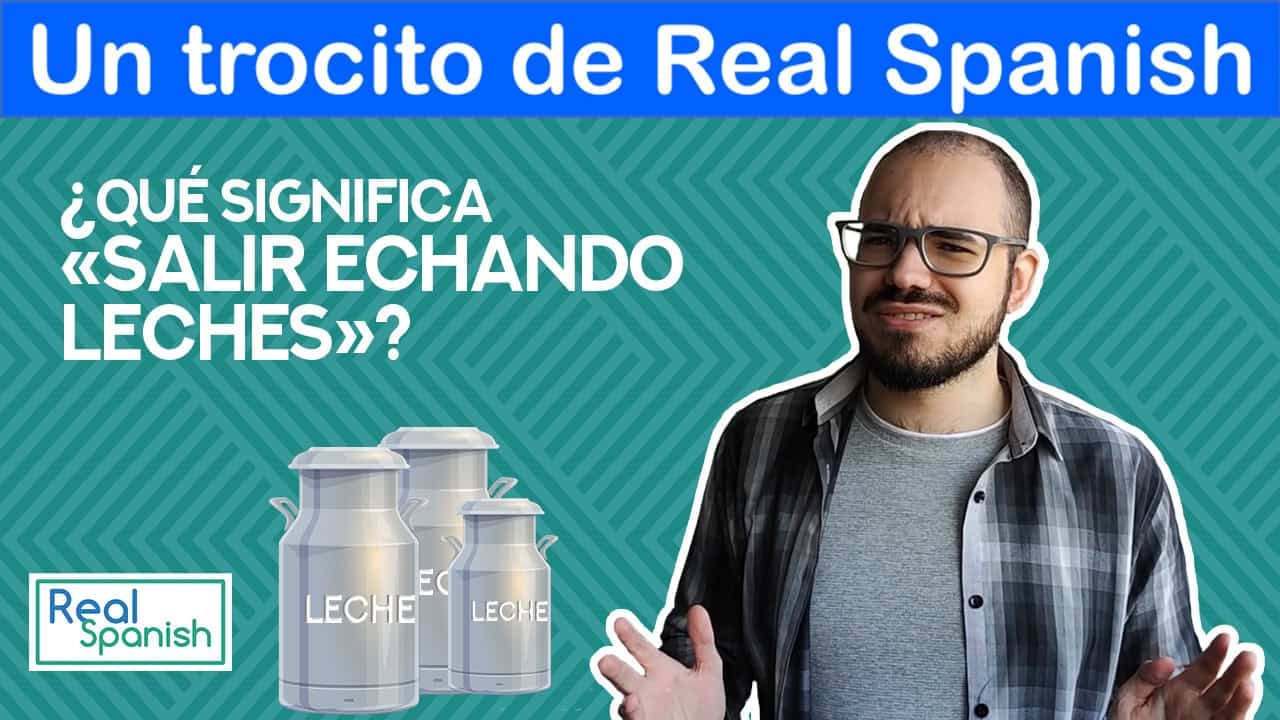
This is a transcription of the video above. There are many colloquial Spanish expressions with the word «leche»— some of them quite vulgar, so be careful! You can find more detailed information in the blog below. If you'd just like to listen to the audio (while you're cooking, doing the laundry, or riding the bus) you can get it on Soundcloud. English transcription: Hi! I'm Miguel, a teacher on Real Spanish. I'm sure you have often heard the word «leche» in colloquial conversations. Well it has many meanings. Some of these expressions are quite vulgar, from "semen" to "to hit oneself" (darse una leche), depending on the context.  But today I’m going to explain the meaning and origin of the phrase «ir (o salir) echando leches», which means “to rush” or “to be in a hurry". The expression comes from way back, when the milkman or milkmaid delivered milk to people’s homes. They were always in a hurry so that the milk was there for breakfast by the time people got up. The milk often spilled over if the pail was full to overflowing. I mean, the milkman or milkmaid rushed around spilling milk on the ground. Another expression with the same meaning is «cagando leches». It sounds vulgar, right? Well, when a horse carried the milk churn, the milk often spilled over, forming puddles on the ground, as if the horse were shitting. Milk is very important in Spanish culture. La lechera de Burdeos, a famous painting by Goya from 1827, was reproduced in this stamp in 1996. If you’re interested in learning more expressions with «leche», you’ll like our mini-lesson «¡Eres la leche!», where we explain half a dozen more expressions, all very colloquial. The mini-lesson comes with an annotated transcription, a set of grammar notes, and interactive exercises. You can buy the mini-lesson on its own, or you can save 20% if you buy a pack of 5 mini-lessons. Bye for now! In the blogpost below you'll learn a lot more expressions with «leche».  Click here to learn more about the mini-lesson Blogpost: The word «leche» is used a lot in Spanish, not only to refer to the milk of animals such as cows, goats and sheep, or mother’s milk for babies. The dictionary of the Royal Academy of Spanish (Real Academia Española, RAE) gives nine different meanings for the word. Some of these are very colloquial; for example, «una leche» may be a slap to the face. There are also many colloquial expressions featuring the word «leche». You can see more examples below. Milk and milk products have been part of the gastronomy of Spain for more than 11,000 years. Milk is a component of the Mediterranean diet and is used in many traditional dishes and recipes such as leche merengada, (a dessert prepared with egg yolks, sugar and cinnamon), leche frita (“fried milk”, made with flour, milk and sugar) and arroz con leche (rice pudding). In some Latin American countries such as Argentina o Nicaragua,

A toda velocidad

At top speed!

Co-author: Gema Benítez Sánchez There are so many interesting expressions that you can use to make your Spanish sound more colloquial and more natural! We’ll bring you some of them in this blog, as well as in all our lessons based on movies and TV programmes. Today, we’ll introduce you to some expressions about speed. Did you catch the expression a toda pastilla in the home page video? A toda pastilla: at top speed, flat out, full throttle, full pelt, foot down, pedal to the metal… depending on context. Of course you can say a toda velocidad, or muy rápido, but your speech will be more expressive (and impressive) if you can use some of the expressions below. Expression Possible origin of the phrase Example in context a toda pastilla Pastillas are used in electric musical instruments to create sound. A toda pastilla is at maximum volume. ¡Qué cansada estoy! Llevo todo el día a toda pastilla, corriendo de un lado a otro sin parar. a toda mecha Una mecha is a fast-burning fuse used to ignite something quickly (such as dynamite). ¡Qué cansada estoy! Llevo todo el día a toda mecha, corriendo de un lado a otro sin parar. a toda máquina Machines work much faster than human beings. Estos empleados trabajan a toda máquina para que los clientes reciban sus compras en casa a tiempo. a toda marcha Marcha is march, or pace, so a toda marcha is at full speed (“Quick march!”) La nueva campaña publicitaria va a toda marcha, muy pronto estará terminada. a la velocidad del rayo As in English, at lightning speed Esa mujer ha cruzado la calle a la velocidad del rayo, parece que tiene mucha prisa. a toda caña This expression comes from dar caña, which comes from the world of horse racing: to flog or whip (the horse). In this case la caña is a whip. Van conduciendo sus motos a toda caña, es un peligro para todos.